AI Appraisal Estimate

AI-generated estimates · not official valuations

From the user

What was submitted

Photo and notes provided by the user — not generated by AI

Submitted item photo
Submitted photo · June 10, 2026

User's notes

No additional notes provided.

AI analysis below

AI appraisal

AI analysis & estimate

AI-Generated · Verify before acting

Everything below is generated by AI for informational purposes only. AI can make mistakes — the AI may misidentify items or misattribute them (artist, maker, brand, designer, origin, era). This is not an official valuation and should not be used for insurance, sale, tax, estate, legal, or lending purposes — or any decision requiring a certified appraisal. It is not an authoritative claim about any person, brand, or rights holder — do not share or rely on it as a factual statement about a third party. Always consult qualified professionals before making financial decisions.

Read the full disclaimer

AI Identification

·Not independently authenticated·Verify before acting

Carved Stone Elephant Figurine Set

Decorative Arts

AI Estimated Value

·Not an official valuation·Verify before acting

$40-70

As of June 10, 2026

AI Item Analysis

·AI can make mistakes·Verify before acting
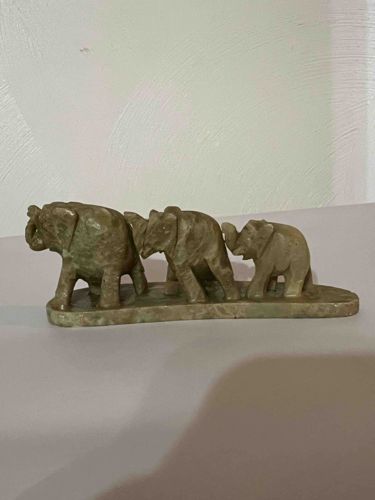
This item is a decorative sculpture depicting three elephants, ranging from largest to smallest, walking in a line on a unified base. The elephants and base appear to be carved from a single piece of natural stone, likely a type of soapstone or jade given its variegated green and brown hues. The surface exhibits a relatively smooth finish, though some areas retain a slightly rougher, more organic texture, suggesting hand-carving. The color palette ranges from a desaturated olive green to muted brownish-grey tones, characteristic of natural stone with veins and inclusions. Each elephant is depicted with simplified, rounded forms, emphasizing the bulk of the animals rather than intricate details of the skin or musculature. Trunks are lowered, and ears are depicted as flat, broad shapes. No discernible maker's marks, signatures, or stamps are visible on the depicted surfaces. The condition appears good with a natural patina from age and handling, and no obvious chips, cracks, or repairs are visible. The craftsmanship suggests a folk art or souvenir quality, common in carved stone items from various regions, possibly dating from the mid to late 20th century. The consistent style and material indicate they were conceived as a single artistic piece. This piece exemplifies a decorative item crafted from natural materials, valued more for its aesthetic display and material characteristics than sophisticated artistry or historical significance. The varying sizes of the elephants add a dynamic and hierarchical element to the composition, suggesting a family or herd.
AI Appraisal Report

·AI can make mistakes·Verify before acting
Based on my visual examination of the provided image, this carved stone elephant figurine set appears to be in good overall condition. I observe a natural patina consistent with age and handling, and there are no obvious chips, cracks, or repairs visible. The crafting style, material (likely soapstone or similar soft stone), and simplified forms suggest a decorative folk art or souvenir quality piece, most probably dating from the mid to late 20th century. Authenticity as a genuine period piece within that timeframe seems high, given the material characteristics. Market conditions for such carved stone decorative items are generally modest. Comparables in online marketplaces and auction results for similar soapstone or jade-like carved animal figurines of this scale and level of detail typically fall within a modest price range. Demand for these types of decorative arts is stable but not high, primarily appealing to collectors of natural stone carvings or elephant motifs. Rarity is low; many similar pieces were produced. The varying sizes add some visual interest but do not significantly elevate the value beyond similar single or grouped carvings. Factors significantly impacting value are the commonality of the material and craftsmanship, placing it firmly in the decorative rather than fine art category. Without intricate details, a known carver, or historical provenance, it functions primarily as a decorative accent. For full authentication and a more precise dating, an in-person examination would allow for tactile assessment of the stone's type, weight, and the precise nature of the carving marks. Microscopic analysis could confirm the stone type and rule out modern imitations. Provenance documentation, such as original sales receipts or family history, would also be invaluable but is rarely available for such items.

Get your items appraised

Instant estimates of your treasures with AI-powered appraisals

Browse More Appraisals