AI estimate as of August 16, 2025 · verify with a professional before acting
AI-Generated · Verify before acting
Everything on this page is generated by AI for informational purposes only. AI can make mistakes — the AI may misidentify items or misattribute them (artist, maker, brand, designer, origin, era). This is not an official valuation and should not be used for insurance, sale, tax, estate, legal, or lending purposes — or any decision requiring a certified appraisal. It is not an authoritative claim about any person, brand, or rights holder — do not share or rely on it as a factual statement about a third party. Always consult qualified professionals before making financial decisions.
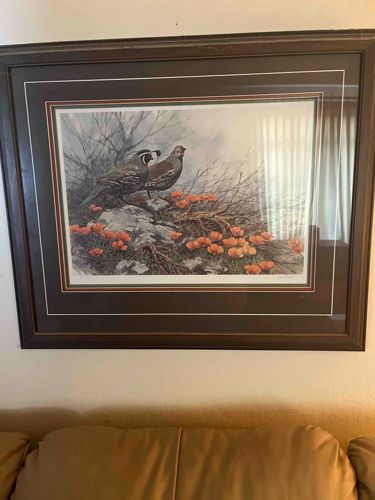
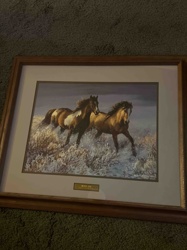
The item is a framed art print depicting two quail, likely California Quail given their distinctive head plumes, perched on what appears to be rocks amidst a field of vibrant orange poppies or similar flowering plants. The background suggests a muted, possibly foggy or overcast sky, with sparse, intricate branches of bare trees contributing to a slightly melancholic yet naturalistic atmosphere. The print itself appears to be a color lithograph or giclée, characterized by its detailed rendition of the birds' plumage and the delicate structures of the flowers. The color palette is dominated by the browns, grays, and whites of the birds and their rocky perch, contrasted sharply with the warm oranges of the flowers and hints of green foliage. The print is housed within a substantial, dark brown wooden frame, likely stained or painted to achieve its rich, deep tone. The frame features a classic, somewhat ornate profile. Inside the frame, there are multiple mats; an inner, thinner dark red/brown mat directly borders the artwork, followed by a wider, lighter gray or off-white mat, and then another thin dark mat closest to the frame's edge. This multi-matting technique adds depth and visual interest. The glass covering the print shows some reflections, indicating it is likely standard picture frame glass. There appear to be no significant visible condition issues such as tears, creases, or major discoloration on the print itself, though some slight dust or glare is present on the glass. The frame seems to be in good condition, with no obvious chips or cracks, and wear consistent with age. Without visible signatures or edition numbers, it's hard to ascertain manufacturing specifics beyond being a mass-produced print. The style suggests a late 20th to early 21st-century wildlife art aesthetic.
AI Appraisal Report
Upon visual examination of this 'Quail and Poppies' framed art print, my assessment of its condition is good. The print itself appears free from tears, creases, or significant discoloration, with colors still vibrant. The multi-matted, dark wooden frame is in good condition, showing no obvious chips or cracks. Authenticity, based solely on this image, is limited. It presents as a mass-produced print, likely a lithograph or giclée, rather than an original artwork or limited edition signed print, given the lack of visible signatures, edition numbers, or artist's proof marks.
Market conditions for such decorative art prints are generally stable but not exceptionally strong, unless tied to a highly renowned artist or specific collectible series. Comparable framed wildlife prints of similar aesthetic and quality typically range from $75 to $150 in the secondary market, depending on the artist (if known) and overall presentation. Demand for general decorative wildlife art remains consistent, but rarity is low for mass-produced prints. The primary value drivers here are the appealing subject matter, good condition of both print and frame, and the attractive multi-matting which enhances its display value.
Factors significantly impacting value include the potential for the print to be by a recognized wildlife artist (currently undeterminable) or part of a numbered limited edition. The presence of standard glass, rather than UV-protective or non-glare options, is a minor detractor.
For full authentication, an in-person examination is crucial to inspect the print surface for specific printing techniques (e.g., dot patterns for lithography, texture for giclée), examine edges for watermarks or plate marks, and check the reverse for any labels, edition numbers, or artist's signatures often obscured by framing. Provenance documentation, such as purchase receipts or certificates of authenticity, would definitively establish its origins and potential edition status. Scientific testing, like UV light examination, could reveal any repairs or hidden damage, though this is usually reserved for higher-value pieces.