These notes were written by the person who submitted this item. Appraiser.AI has not verified them, and the AI's identification and estimate may rely on them.
AI Estimated Value
Not an official valuation
$25-75
AI estimate as of December 6, 2025 · verify with a professional before acting
AI-Generated · Verify before acting
Everything on this page is generated by AI for informational purposes only. AI can make mistakes — the AI may misidentify items or misattribute them (artist, maker, brand, designer, origin, era). This is not an official valuation and should not be used for insurance, sale, tax, estate, legal, or lending purposes — or any decision requiring a certified appraisal. It is not an authoritative claim about any person, brand, or rights holder — do not share or rely on it as a factual statement about a third party. Always consult qualified professionals before making financial decisions.
This analysis also relies on unverified notes provided by the user, which may be incomplete or inaccurate and could affect the result.
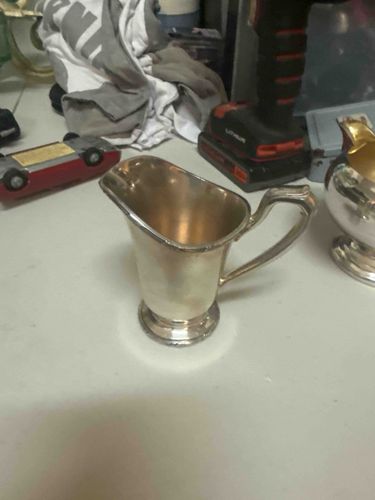
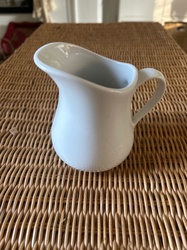
The item is a small, silver-toned pitcher, likely functioning as a creamer or a small serving vessel for sauces. It exhibits a classic, slightly flared body that tapers gently towards the base, which is supported by a circular, stepped foot. The material appears to be polished metal, possibly silverplate or sterling silver, given its lustrous, reflective surface, although some tarnishing or dulling is visible, particularly in the recesses and around the base, indicating age or lack of recent polishing. The handle is an elegant, ornate C-scroll design, with a somewhat angular bend near the top and bottom, suggesting a traditional or Georgian-revival aesthetic. The rim of the pitcher is slightly everted with a subtle pour spout on one side, hinting at its intended use for liquids. The interior also presents a reflective, metallic finish, consistent with the exterior. The overall condition suggests moderate wear consistent with use and age; there are no immediately obvious dents or significant damage, but surface scratches and minor imperfections might be present upon closer inspection. The craftsmanship appears to be of decent quality, with smooth transitions between components, indicative of a manufactured item from the early to mid-20th century, or possibly earlier, depending on the specific hallmarks which are not visible in the image. Its size suggests it is designed for individual or small group servings, rather than a large carafe.
AI Appraisal Report
Upon visual examination of the provided images, this item appears to be a small silver pitcher, likely a creamer, consistent with early to mid-20th-century design, possibly in a Georgian-revival style. The C-scroll handle, stepped circular foot, and everted rim are classic features of this period. The overall condition appears fair to good for its age, with visible tarnishing and signs of use but no major dents or structural damage immediately apparent from the photographs.
The primary factor determining this item's value is its metallic composition. If it is silverplate, its value is largely decorative and would fall on the lower end of the estimated range. If it is sterling silver, its value would be higher, based on its weight in silver (melt value) plus a premium for its form and craftsmanship. The current market for individual silverplate creamers is relatively soft, with a large supply available. Even for sterling examples, the market is driven more by silver weight than collectibility unless the piece is from a highly desirable maker like Tiffany & Co., Gorham, or Reed & Barton, or possesses exceptional historical significance. Without maker's marks, it is treated as a generic example.
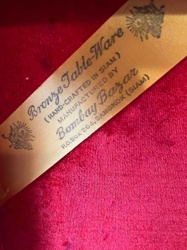
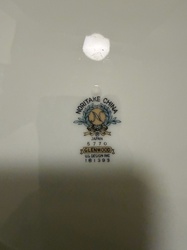
This appraisal is strictly limited by the inability to physically inspect the item. A definitive valuation requires an in-person examination to identify hallmarks or maker's marks, which would confirm the material (sterling vs. silverplate), manufacturer, and origin. Chemical testing for silver content would be necessary to authenticate the metal if marks are absent or illegible. As such, the provided value reflects its likely value as a generic silverplate or a lightweight, unmarked sterling piece. Full authentication cannot be completed from images alone.