AI estimate as of September 7, 2025 · verify with a professional before acting
AI-Generated · Verify before acting
Everything on this page is generated by AI for informational purposes only. AI can make mistakes — the AI may misidentify items or misattribute them (artist, maker, brand, designer, origin, era). This is not an official valuation and should not be used for insurance, sale, tax, estate, legal, or lending purposes — or any decision requiring a certified appraisal. It is not an authoritative claim about any person, brand, or rights holder — do not share or rely on it as a factual statement about a third party. Always consult qualified professionals before making financial decisions.
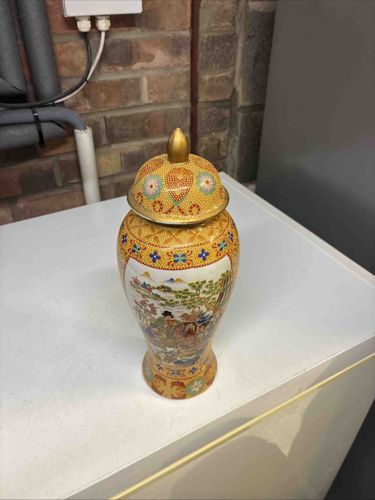
This is a decorative ceramic ginger jar, likely crafted from porcelain, featuring a 'Famille Jaune' or similar polychrome enamel decoration. The jar is of a classic ginger jar shape, characterized by a rounded body tapering towards a narrow neck, and is topped with a fitted lid that has a finial. The dominant color scheme is a rich yellow (jaune), serving as the background for intricate patterns. The jar and lid are adorned with meticulous stippling or 'millefiori' like patterns in yellow, orange, and red tones, creating a textured visual effect. Floral motifs and geometric borders in blue, green, and red further embellish these areas. \n\nA prominent decorative band encircles the central body of the jar, showcasing detailed figural and landscape scenes. These scenes depict traditional Asian figures, possibly engaged in daily activities or narratives, set against a backdrop of mountains, trees, and architectural elements. The painting exhibits fine brushwork and a vibrant palette of greens, blues, browns, and reds. The lid mirrors the ornamental style of the jar's upper and lower bands, with the same stippled yellow background and colorful floral/geometric designs. The finial on the lid is a contrasting metallic gold, possibly gilded, and has a teardrop or conical shape. \n\nIn terms of condition, the jar appears to be in good visible condition with no obvious chips, cracks, or significant loss of paint from the provided image. The colors remain vibrant, suggesting good preservation. There might be minor wear consistent with age and handling, such as subtle scuffs or faint surface marks, but these are not clearly discernible. The craftsmanship suggests a moderately high level of detail, particularly in the painted scenes and the intricate background patterns. This type of jar is often associated with late 19th to mid-20th-century Asian export porcelain, though without specific marks, a precise age is difficult to determine.
AI Appraisal Report
Based on my examination of the provided image, this Famille Jaune style ginger jar appears to be in very good visible condition. There are no obvious chips, cracks, or significant paint loss discernible from the photograph. The vibrant colors and intricate details suggest good preservation, consistent with an item that has been well-cared for. The craftsmanship, particularly in the detailed figural and landscape scenes and the stippled 'millefiori' like background, indicates a moderately high level of skill.
This style of decorative porcelain, often referred to as Famille Jaune due to its dominant yellow background, was popular in Asian export wares, particularly from the late 19th to mid-20th centuries. While attractive, these pieces are relatively common in the market, impacting their rarity. Demand for such decorative ginger jars remains steady, driven by collectors of Asian art and those seeking decorative accents for their homes. Comparables in the current market suggest similar pieces with good condition and detailed decoration typically fall within this value range.
Factors that significantly impact value include the overall artistic quality, the complexity and detail of the painted scenes, and the condition. The excellent condition observed here is a positive attribute.
It is crucial to note the limitations of appraising solely from images. Authenticity and precise dating cannot be definitively determined without a physical examination. An in-person inspection would allow me to check for specific maker's marks or reign marks, assess the weight and feel of the porcelain, examine the glaze quality, and look for any subtle repairs or hairline cracks not visible in the photograph. Provenance documentation, such as purchase receipts or family records, would also greatly assist in verifying its history and authenticity. Scientific testing, if necessary, could provide further insights into the materials and age, but is typically reserved for high-value or questionable items.