AI estimate as of September 12, 2025 · verify with a professional before acting
AI-Generated · Verify before acting
Everything on this page is generated by AI for informational purposes only. AI can make mistakes — the AI may misidentify items or misattribute them (artist, maker, brand, designer, origin, era). This is not an official valuation and should not be used for insurance, sale, tax, estate, legal, or lending purposes — or any decision requiring a certified appraisal. It is not an authoritative claim about any person, brand, or rights holder — do not share or rely on it as a factual statement about a third party. Always consult qualified professionals before making financial decisions.
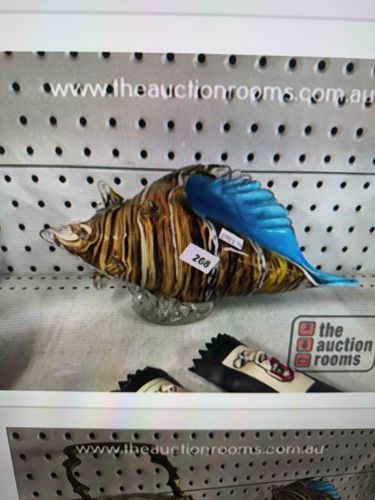
This item is a decorative glass sculpture designed in the form of a tropical fish, likely inspired by Murano glass artistry. The body of the fish features a striking pattern of vertical stripes in various shades of brown, amber, and clear glass, giving it a tiger-like or banded appearance. The dorsal fin and tail are a vibrant, translucent blue, contrasting sharply with the warm tones of the body. The fish has a pointed snout and is depicted with a somewhat stylized, elongated form. It appears to be made from blown or lamp-worked glass, showcasing delicate craftsmanship. The base of the sculpture is clear glass, molded into a small, irregular shape, possibly resembling rocks or coral, providing a stable stand for the fish. The overall size appears to be medium, suitable for a display shelf or cabinet. There are no visible chips, cracks, or significant damage in the provided image, suggesting good overall condition. The quality of the glasswork, particularly the intricate striping and the vibrant color of the fins, indicates a skilled artisan. A white tag with '268' written on it is affixed to the side of the fish, likely an auction or inventory number. The item seems to be without any obvious maker's marks, but its style strongly suggests a mid to late 20th-century decorative art piece.
AI Appraisal Report
Based on my visual examination of the provided image, this Murano style glass tropical fish sculpture appears to be in very good to excellent condition, showing no visible chips, cracks, or significant damage. The intricate vertical stripes in brown, amber, and clear glass for the body, coupled with the vibrant translucent blue dorsal fin and tail, suggest a skilled hand in its creation, likely through blown or lamp-worked glass techniques. The clear glass base, molded to resemble coral or rocks, provides a stable and aesthetically pleasing stand.
Authenticity: While the style is strongly reminiscent of Murano glass artistry, it's crucial to note that without a visible maker's mark, signature, or a reliable provenance, I cannot definitively authenticate this as true Murano glass from the image alone. The term 'Murano style' is often used for pieces that emulate the aesthetics and techniques without necessarily originating from Murano, Italy. The presence of the '268' tag is likely an inventory or auction number and does not contribute to authenticity.
Market Conditions & Comparables: Decorative glass fish sculptures, especially those showcasing color and craftsmanship like this one, generally have a steady demand among collectors of art glass and interior decorators. Similar 'Murano style' pieces by skilled, albeit often unidentifiable, artisans typically fetch modest prices. True Murano pieces with documented provenance or signatures would command significantly higher values.
Factors Impacting Value: The excellent condition enhances its appeal. The lack of a definitive attribution to a specific Murano factory or artist is the primary limiting factor in its value. The quality of the glasswork, particularly the intricate striping and vibrant colors, indicates a higher-end 'style' piece, distinguishing it from mass-produced items.
Limitations & Verification: For a full authentication, an in-person examination is critical to assess the glass quality, pontil mark, and any microscopic details that might reveal manufacturing techniques specific to Murano. Provenance documentation (e.g., original purchase receipts, certificates of authenticity) and potentially scientific testing of the glass composition would be necessary to confirm its origin definitively. Without these, it remains a beautiful and well-crafted 'Murano style' decorative piece.