AI estimate as of August 16, 2025 · verify with a professional before acting
AI-Generated · Verify before acting
Everything on this page is generated by AI for informational purposes only. AI can make mistakes — the AI may misidentify items or misattribute them (artist, maker, brand, designer, origin, era). This is not an official valuation and should not be used for insurance, sale, tax, estate, legal, or lending purposes — or any decision requiring a certified appraisal. It is not an authoritative claim about any person, brand, or rights holder — do not share or rely on it as a factual statement about a third party. Always consult qualified professionals before making financial decisions.
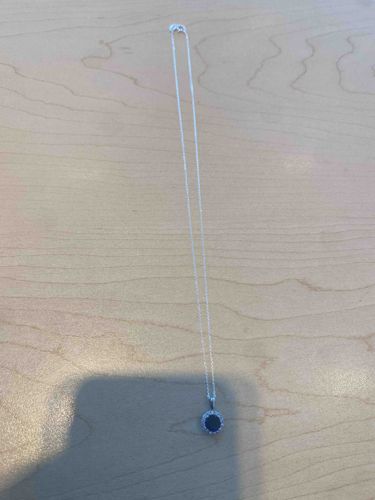
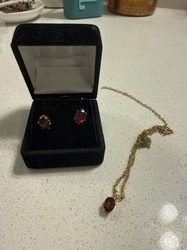
This item is a necklace featuring a circular pendant with a dark blue, possibly sapphire or dark glass, central stone surrounded by a halo of small, clear, faceted stones, likely diamonds or cubic zirconia. The pendant is suspended from a thin, silvery-colored chain, which appears to be a box chain or a similar delicate link style, common in modern jewelry. The overall length of the necklace is such that it would likely sit around the collarbone or slightly below, a typical length for many pendants. The metal of the chain and the setting of the pendant appear to be polished silver-tone, possibly sterling silver or white gold, given the luster and reflectivity. No manufacturer's marks or specific hallmarks are visible in the provided image, so the exact metal content and maker are undeterminable from this view alone. The craftsmanship appears to be good, with all stones securely set. There are no obvious signs of significant wear, damage, or patina on the visible surfaces, suggesting it is either well-maintained or relatively new. The design is classic and elegant, often associated with contemporary jewelry styles. The clear surrounding stones offer a sparkling contrast to the opaque or translucent dark blue central element, enhancing its visual appeal. The clean lines and traditional design elements indicate it could be from the late 20th or early 21st century.
AI Appraisal Report
Upon visual examination of the provided image, I assess this necklace to be in excellent condition. There are no visible signs of wear, damage, or significant patina. The design is a classic halo pendant, featuring a central dark blue stone (likely sapphire or high-quality simulated stone) surrounded by clear, faceted stones (appearing to be diamonds or cubic zirconia) set in a silver-tone metal. The chain appears to be a delicate box chain. Authenticity of materials (e.g., natural sapphire vs. synthetic, diamond vs. CZ, sterling silver vs. white gold) cannot be definitively confirmed from an image alone. The craftsmanship appears good, with stones securely set.
Market conditions for classic halo pendants are consistently strong, as they are versatile and popular. Comparable items, ranging from fine jewelry to fashion pieces, are widely available. Given the potential for the central stone to be sapphire and the clear stones to be diamonds, and the quality of the setting, this piece aligns with what one might find in a mid-tier jewelry market. Demand for such timeless designs remains high, though this specific piece is not rare.
Factors significantly impacting value include the actual material composition. If the blue stone is natural sapphire and the clear stones are diamonds, with the metal being white gold or platinum, its value would be considerably higher. Conversely, if it is a simulated blue stone, cubic zirconia, and silver-plated base metal, the value would be much lower.
Limitations in authenticity verification are significant. Without in-person examination, I cannot determine the exact type of blue stone (natural/synthetic sapphire, glass), the clear stones (diamond/CZ/other), or the metal content (sterling silver/white gold/plated base metal). A gemological certificate for the stones, hallmark verification for the metal, and a physical inspection to assess weight and construction are crucial for a full and accurate authentication and appraisal. As such, this appraisal relies solely on visible aesthetics.