AI Appraisal Estimate

AI-generated estimates · not official valuations

From the user

What was submitted

Photo and notes provided by the user — not generated by AI

Submitted item photo
Submitted photo · June 6, 2026

User's notes

Maker and value

AI analysis below

AI appraisal

AI analysis & estimate

AI-Generated · Verify before acting

Everything below is generated by AI for informational purposes only. AI can make mistakes — the AI may misidentify items or misattribute them (artist, maker, brand, designer, origin, era). This is not an official valuation and should not be used for insurance, sale, tax, estate, legal, or lending purposes — or any decision requiring a certified appraisal. It is not an authoritative claim about any person, brand, or rights holder — do not share or rely on it as a factual statement about a third party. Always consult qualified professionals before making financial decisions.

Note

This analysis also relies on unverified notes provided by the user, which may be incomplete or inaccurate and could affect the result.

Read the full disclaimer

AI Identification

·Not independently authenticated·Verify before acting

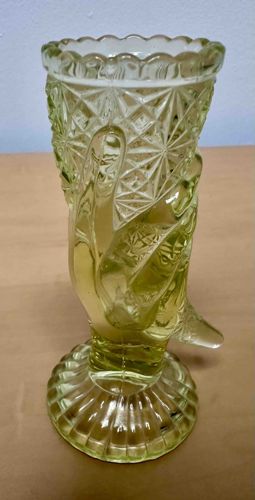
EAPG Hand Holding Vase (Celery Vase)

Decorative Glassware

AI Estimated Value

·Not an official valuation·Verify before acting

$250-400

As of June 6, 2026

AI Item Analysis

·AI can make mistakes·Verify before acting
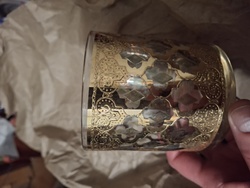
This item is an Early American Pattern Glass (EAPG) celery vase, often referred to as a 'hand holding vase' or 'hand vase.' It is crafted from pressed glass, exhibiting a distinctive pale yellow or greenish-yellow hue, strongly suggesting it is Vaseline glass, which fluoresces brightly under UV light due to the presence of uranium. The vase stands on a circular, fluted base with radial pleats, providing stability and an ornate touch. Rising from the base is a sculptural element of a hand, finely molded with clearly defined fingers and a thumb, appearing to grasp or support the main body of the vase. The vessel itself is cylindrical with a slightly flared, scalloped or crimped rim. Its surface is adorned with a complex geometric pressed pattern, commonly known as 'Diamond and Star,' characterized by intersecting diagonal lines forming diamond shapes, each containing a central starburst motif. The craftsmanship is typical of EAPG, with visible mold lines indicating its manufacturing process. There are no obvious chips, cracks, or repairs visible from the provided images, suggesting its condition is good for its age. The overall aesthetic is decorative and characteristic of Victorian-era glass production, likely dating from the late 19th or early 20th century. The unique combination of the figural hand and the elaborate pattern gives it significant appeal to collectors of antique pressed glass.
AI Appraisal Report

·AI can make mistakes·Verify before acting
Based on my visual examination of the provided image, this EAPG Hand Holding Celery Vase presents as a compelling piece of Victorian-era pressed glass. The pale yellow/greenish-yellow hue strongly suggests it is Vaseline glass, a feature that significantly enhances its collectibility, especially if it indeed fluoresces under UV light. The detailed 'Diamond and Star' pattern, coupled with the figural hand grasping the vessel, exemplifies the ornate aesthetics popular during the late 19th/early 20th century. Condition appears good from the image; I detect no obvious chips, cracks, or repairs, which is crucial for antique glass value. The visible mold lines are consistent with EAPG manufacturing. Market conditions for EAPG remain stable, with unique forms and good condition pieces drawing consistent interest. Comparables for 'hand holding' vases, particularly those in desirable colors like Vaseline, typically fetch premium prices. The combination of the distinctive form, the patterned glass, and the probable Vaseline characteristics contributes to its rarity and demand. While EAPG is not excessively rare, specific patterns combined with figural elements and special glass types are highly sought after. Factors significantly impacting value here are its condition, the Vaseline glass attribute (assuming UV confirmation), and the popular 'hand vase' motif. Without physical inspection, I cannot definitively confirm the Vaseline characteristic or rule out minute flaws such as fleabites or internal fractures. A physical examination under UV light would be necessary to confirm the Vaseline glass, and a thorough tactile inspection would be required to verify condition comprehensively. Provenance documentation, while helpful, is not typically critical for EAPG authentication beyond confirming the period.

Get your items appraised

Instant estimates of your treasures with AI-powered appraisals

Browse More Appraisals