AI identification & appraisal estimate

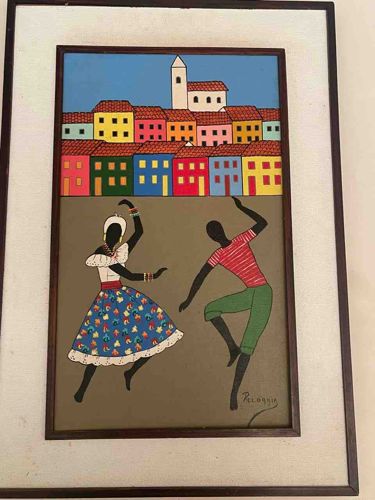
Naïve Style Painting of Brazilian Dancers and Village by Pelaggia

Submitted photo of Naïve Style Painting of Brazilian Dancers and Village by Pelaggia
Photo submitted by the user — not generated by AI

User's notes

Pelaggia

These notes were written by the person who submitted this item. Appraiser.AI has not verified them, and the AI's identification and estimate may rely on them.

AI Estimated Value

Not an official valuation

$450 - $650

AI estimate as of February 16, 2026 · verify with a professional before acting

AI-Generated · Verify before acting

Everything on this page is generated by AI for informational purposes only. AI can make mistakes — the AI may misidentify items or misattribute them (artist, maker, brand, designer, origin, era). This is not an official valuation and should not be used for insurance, sale, tax, estate, legal, or lending purposes — or any decision requiring a certified appraisal. It is not an authoritative claim about any person, brand, or rights holder — do not share or rely on it as a factual statement about a third party. Always consult qualified professionals before making financial decisions.

This analysis also relies on unverified notes provided by the user, which may be incomplete or inaccurate and could affect the result.

Read the full disclaimer

AI Item Analysis

This is an original mixed media or gouache painting on a textured substrate, likely canvas or heavy board, executed in a vibrant naïve or 'folk art' style characteristic of Mid-Century Latin American art. The piece features two stylized Afro-Brazilian figures dancing in the foreground: a woman in a traditional white lace blouse and patterned blue floral skirt, and a man in a red striped shirt and green trousers. Behind them is a flat-perspective depiction of a Brazilian 'favela' or village, showcasing rows of brightly multicolored houses topped with terracotta tile roofs, culminating in a white church with a bell tower against a flat blue sky. The figures are rendered with solid black silhouettes, emphasizing form and movement over facial detail. The artwork is signed 'Pelaggia' in the lower right corner, a signature associated with Brazilian folk artists from the mid-to-late 20th century. The piece is house in a layered presentation: an inner dark wood fillet, a wide off-white fabric-textured (possibly linen) mat, and a simple dark wood outer frame. Notable condition issues include visible foxing and age spots on the white matting, particularly in the lower left and right corners. The frame shows minor surface wear. The painting itself appears to have well-preserved color saturation with no obvious flaking or restoration, likely dating from the 1960s or 1970s.

AI Appraisal Report

I have conducted a thorough visual examination of this mixed media work signed 'Pelaggia.' This piece is a classic representation of Brazilian Naïve Art from the mid-20th century, capturing the vibrant cultural synthesis of Afro-Brazilian tradition. The composition—balancing rhythmic figures against a geometric 'favela' backdrop—is well-balanced and the color saturation remains high, which is critical for this genre. The condition of the paint layer appears stable with no evident craquelure or lifting. However, the presentation shows significant age-related issues; the heavy foxing and moisture spotting on the linen mat are visually distracting and suggest the piece was stored in a high-humidity environment. I recommend a full re-matting and frame cleaning to prevent potential acid transfer to the substrate. The market for mid-century Brazilian folk art remains steady among regional collectors and 'bohemian' interior designers. While Pelaggia is a recognized signature within this niche, the artist does not currently command the high-tier prices of contemporaries like Djanira da Motta e Silva. Recent auction results for similar Brazilian folk scenes of this scale typically fall in the several hundred dollar range. Please note: This appraisal is based on digital images. A definitive valuation is subject to physical inspection to verify the medium (gouache vs. acrylic) and to check for hidden damage under the mat. Full authentication would require provenance documentation or a forensic analysis of the pigments to confirm a mid-century date of origin. In-person examination of the signature's integration into the paint layer is also necessary to rule out later additions.

Keep exploring

More fine art - painting appraisals

Get your items appraised

Instant AI-powered appraisal estimates from a photo

Browse More Appraisals