AI estimate as of September 27, 2025 · verify with a professional before acting
AI-Generated · Verify before acting
Everything on this page is generated by AI for informational purposes only. AI can make mistakes — the AI may misidentify items or misattribute them (artist, maker, brand, designer, origin, era). This is not an official valuation and should not be used for insurance, sale, tax, estate, legal, or lending purposes — or any decision requiring a certified appraisal. It is not an authoritative claim about any person, brand, or rights holder — do not share or rely on it as a factual statement about a third party. Always consult qualified professionals before making financial decisions.
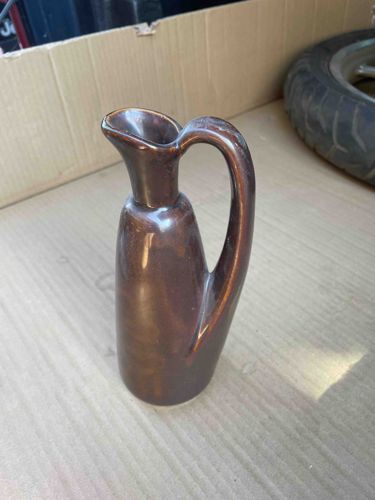
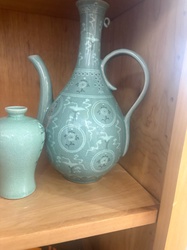
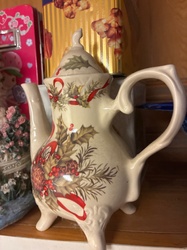
This appears to be a small, single-handled ceramic pitcher or juglet, finished with a rich, dark brown glaze that exhibits a subtle metallic or iridescent sheen in certain lighting conditions, possibly due to the nature of the glaze itself or photographic effects. The overall form is slender and somewhat organic, with a cylindrical body that gently tapers towards a slightly wider base. The item features a prominent spout that extends from the rim, designed for pouring liquids. A gracefully curved handle is attached to the side, spanning from just below the rim to approximately the midpoint of the body, providing a functional grip. The construction suggests it is a molded or thrown piece of pottery, likely ceramic, possibly stoneware or earthenware, given the opaque glaze and robust appearance. There are no visible chips, cracks, or significant damage, suggesting it is in good, used condition. The surface appears smooth with some minor dust or debris, which is superficial. No distinct maker's marks, signatures, or stamps are discernible from the provided image. Its simple yet elegant design, combined with the practical form, hints at a mid-20th century to contemporary style, potentially suitable for serving small quantities of liquids like cream, syrup, or oil, or even as a decorative vase. The quality of craftsmanship seems good, with a well-formed handle and a consistent glaze application.
AI Appraisal Report
Based on my visual examination of the provided image, this brown glazed ceramic pitcher/juglet appears to be in very good, used condition. I observe no chips, cracks, or significant damage, and the glaze application seems consistent. Authenticity, based solely on visual inspection, points towards a well-made, utilitarian piece. The design suggests a mid-20th century to contemporary origin. Without any discernible maker's marks, signatures, or stamps, its specific origin or artist remains unknown, which limits its collectible value.
Market conditions for unmarked, mass-produced or studio pottery such as this are generally stable but not highly speculative. Comparable items, often found in vintage shops or online marketplaces, typically retail in the $30-$80 range, depending on condition and specific aesthetic appeal. Demand for such functional and decorative ceramic pieces is moderate, driven by those seeking vintage home decor or practical serving ware. Rarity is low, given the general abundance of similar ceramic items from the specified period.
Factors significantly impacting value include the lack of maker's marks, which prevents attributing it to a recognized potter or manufacturer, thus reducing its potential as a collectible. Its primary value derives from its aesthetic appeal, functional utility, and good condition.
It is crucial to note the limitations of authenticity verification from images alone. A physical in-person examination would be required to assess the precise weight, tactile qualities of the glaze and clay body, and to meticulously search for any faint marks not visible in the image. Provenance documentation, if any existed, would provide historical context and definitive authentication of origin or maker. Scientific testing, such as thermoluminescence dating, would be necessary for precise age verification if its age were in question, but this is typically not performed on items of this presumed age and value.