AI Appraisal Estimate

AI-generated estimates · not official valuations

From the user

What was submitted

Photo and notes provided by the user — not generated by AI

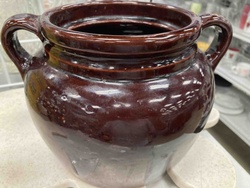
Submitted item photo
Submitted photo · May 18, 2026

User's notes

No additional notes provided.

AI analysis below

AI appraisal

AI analysis & estimate

AI-Generated · Verify before acting

Everything below is generated by AI for informational purposes only. AI can make mistakes — the AI may misidentify items or misattribute them (artist, maker, brand, designer, origin, era). This is not an official valuation and should not be used for insurance, sale, tax, estate, legal, or lending purposes — or any decision requiring a certified appraisal. It is not an authoritative claim about any person, brand, or rights holder — do not share or rely on it as a factual statement about a third party. Always consult qualified professionals before making financial decisions.

Read the full disclaimer

AI Identification

·Not independently authenticated·Verify before acting

Robinson Ransbottom Stoneware Blue Band Pitcher

Kitchenware / Vintage American Pottery

AI Estimated Value

·Not an official valuation·Verify before acting

$45.00 - $65.00

As of May 18, 2026

AI Item Analysis

·AI can make mistakes·Verify before acting
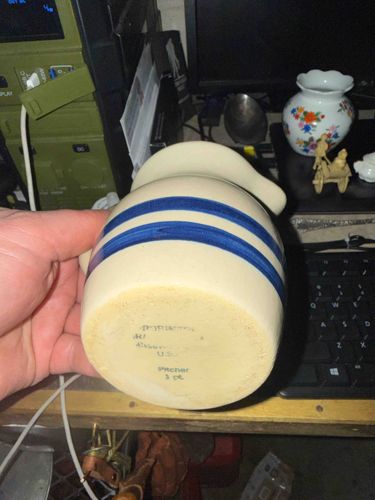
This item is a 1-quart stoneware pitcher, commonly known as a 'beehive' or 'ball' pitcher due to its rounded, bulbous body. It is crafted from heavy, cream-colored stoneware and features the iconic double cobalt blue bands encircling the midsection. The pitcher includes a simple, integrated spout and a sturdy D-shaped handle attached to the back. A significant detail is the bottom-stamped manufacturer's mark, which reads 'ROBINSON RANSBOTTOM R.R.P. CO. Roseville Ohio U.S.A.', indicating it was produced by the Robinson Ransbottom Pottery Company in Zanesville/Roseville, Ohio. Below the maker's mark, the text specifies 'Pitcher 1 qt.', identifying its volume capacity. Regarding condition, the piece shows visible wear on the unglazed bottom rim consistent with its age, likely dating from the mid-20th century. There are minor glaze pops and firing irregularities typical of utility stoneware of this era. The cobalt bands show some minor thinning or application streaks, which is standard for mass-produced salt-glaze or slip-decorated wares. No major cracks or chips are immediately visible in the provided view, though the surface shows light scuffing and a warm patina typical of vintage kitchenware. The craftsmanship is utilitarian but durable, representing classic American industrial pottery design.
AI Appraisal Report

·AI can make mistakes·Verify before acting
I have examined the digital representations of the Robinson Ransbottom Pottery (RRP Co.) 1-quart stoneware pitcher. This piece is a quintessential example of American utility ware from the Zanesville/Roseville region, likely dating to the 1940s-1950s. The 'R.R.P. Co.' bottom stamp is the primary indicator of authenticity, appearing consistent with known factory marks of the era. The cobalt blue banding retains good color saturation, and the 'beehive' form remains highly collectible for farmhouse-style decor. The minor glaze pops and kiln debris noted are considered 'in-the-making' characteristics and do not detract from the value; however, the shelf wear on the unglazed foot confirms its age and utilitarian history. Market demand for RRP Co. is currently stable but influenced by high volume; since these were mass-produced, they are not considered rare. Values for the 1-quart size are lower than the larger 2- or 3-quart versions. I have valued this item based on recent sales of similar cobalt-banded specimens in comparable condition. This appraisal is based on photographic evidence alone, which limits my ability to detect hairline cracks, professional restorations, or subtle 'flea bites' along the inner rim. A definitive authentication would require a tactile 'ring test' to ensure structural integrity and a blacklight (UV) examination to rule out modern resin repairs to the spout or handle joins. No provenance was provided; documented family history or original sales receipts would enhance its historical context but would not significantly move the needle on its market price.

Get your items appraised

Instant estimates of your treasures with AI-powered appraisals

Browse More Appraisals