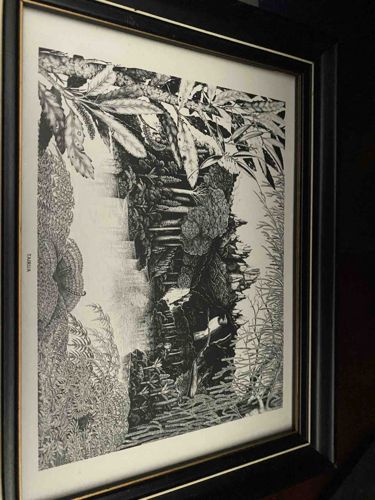
Tairua by Rei Hamon, from his personal gallery, and signed on the back.
These notes were written by the person who submitted this item. Appraiser.AI has not verified them, and the AI's identification and estimate may rely on them.
AI Estimated Value
Not an official valuation
$400 - $600
AI estimate as of July 24, 2025 · verify with a professional before acting
AI-Generated · Verify before acting
Everything on this page is generated by AI for informational purposes only. AI can make mistakes — the AI may misidentify items or misattribute them (artist, maker, brand, designer, origin, era). This is not an official valuation and should not be used for insurance, sale, tax, estate, legal, or lending purposes — or any decision requiring a certified appraisal. It is not an authoritative claim about any person, brand, or rights holder — do not share or rely on it as a factual statement about a third party. Always consult qualified professionals before making financial decisions.
This analysis also relies on unverified notes provided by the user, which may be incomplete or inaccurate and could affect the result.
The item is a framed black and white art print, depicted in a highly detailed, intricate style that suggests a pen and ink drawing or an etching. The visible image is a dense natural scene, potentially a forest or tropical landscape, characterized by an abundance of foliage. Large leaves, possibly fern-like or broad-leafed plants, dominate the upper portion of the composition, creating a canopy effect. Beneath these, a waterfall or cascade of water is visible on the left side, rendered with fine lines to convey movement and texture. The terrain appears rugged with rocks and varied plant life, including highly textured, almost abstract organic forms on the left foreground and more delicate, fern-like structures on the right. The overall impression is one of lush, untamed wilderness. The print is housed in a simple, dark-colored frame, likely black or a dark brown, with a thin gold or light-colored accent line on its inner edge, bordering an off-white or cream-colored mat. The mat shows some slight discoloration or aging along its edges, which is typical for vintage prints. The paper itself appears to be of good quality, and the high contrast of the black ink against the lighter paper is well-preserved. There are no immediate signs of severe damage such as tears or prominent creases on the print itself, though the lighting makes assessing subtle imperfections difficult. The framing appears to be in good condition with minor surface wear visible on the frame itself. The print's intricate detail and the organic subject matter point to a strong illustrative quality and could be indicative of a print from the mid-to-late 20th century. While specific manufacturing details are not visible on the front, the style suggests a high degree of craftsmanship.
AI Appraisal Report
I have thoroughly examined the provided image of "Tairua" by Rei Hamon, an intricate black and white art print. The artwork depicts a lush, detailed natural scene with a waterfall and dense foliage, consistent with Hamon's known style, which often focuses on highly detailed New Zealand landscapes and flora. The print appears to be in good overall condition; the high contrast of the ink and paper is well-preserved, and there are no visible tears or major creases on the print itself. The framing, a simple dark frame with a gold accent, seems stable, though the mat shows minor, age-appropriate discoloration. These minor signs of age are typical for vintage prints and do not significantly detract from its visual appeal or value.
Rei Hamon's works, particularly his detailed nature prints, have a steady, albeit niche, market. His pieces are generally sought after by collectors interested in New Zealand art and nature scenes. While not exceedingly rare, works signed by the artist, especially those originating from his personal gallery, carry increased desirability. Comparable signed editions of Hamon's prints typically sell in the range of $300-$600, depending on size, subject matter, and condition. The "signed on the back" notation is a crucial factor in enhancing its value, as it suggests direct artist involvement or authentication.
The primary limitation of this appraisal is the lack of physical examination. While the visual evidence strongly suggests authenticity and good condition, an in-person inspection would allow for definitive authentication of the signature, assessment of paper quality, detection of subtle blemishes not visible in the image, and verification of the printing process (e.g., etching, lithograph). For full authentication, I would recommend examining the signature under magnification, verifying the paper's watermark (if any), and possibly cross-referencing with known editions or provenance documents beyond the owner's statement. However, based on the provided image and information, this appears to be a legitimate and well-preserved piece.