AI estimate as of October 3, 2025 · verify with a professional before acting
AI-Generated · Verify before acting
Everything on this page is generated by AI for informational purposes only. AI can make mistakes — the AI may misidentify items or misattribute them (artist, maker, brand, designer, origin, era). This is not an official valuation and should not be used for insurance, sale, tax, estate, legal, or lending purposes — or any decision requiring a certified appraisal. It is not an authoritative claim about any person, brand, or rights holder — do not share or rely on it as a factual statement about a third party. Always consult qualified professionals before making financial decisions.
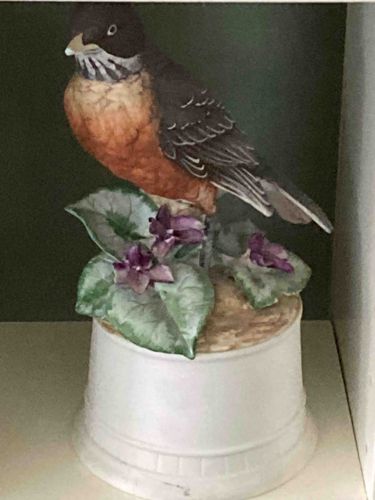
This item is a decorative figurine featuring an American Robin perched amidst artificial violet flowers and leaves, mounted on a faux pot or pedestal base. The robin is realistically rendered with a dark, almost black head, a distinctive white throat with dark streaking, and a vibrant reddish-orange breast and lower belly. Its back and wings are a dark greyish-brown, with individual feather details subtly sculpted and painted, including delicate white tips on some wing feathers. The bird's beak appears to be a light beige or off-white color. The violets are depicted with green, somewhat fuzzy-textured leaves, showing veins and slight variations in color indicative of natural foliage. The flowers themselves are a deep purple hue, appearing to be clustered in small arrangements. All components, including the bird, flowers, and leaves, are likely crafted from ceramic, porcelain, or resin, given their glossy finish and sculpted details. The base is an off-white or cream color, shaped like a small, tapered pot or pedestal with a subtle ribbed or fluted design at its lower edge, suggesting a classical architectural element or a planter. The overall construction suggests it is a single, integrated piece. The condition appears good, with no immediately visible chips, cracks, or significant wear, although some minor dust or surface grime might be present from display. The style is primarily naturalistic, aiming for a realistic portrayal of the bird and flora, often associated with a late 20th-century to early 21st-century decorative aesthetic. The craftsmanship seems of good quality, with attention to detail in the painting and sculpting of the bird and flowers, making it suitable for display as a decorative accent.
AI Appraisal Report
I have virtually examined this American Robin Figurine on Faux Pot Base with Violets. Based on the provided image, the figurine appears to be in good condition, showing no readily apparent chips, cracks, or significant wear. The paint application exhibits reasonable detail for a mass-produced decorative item. Authenticity, in terms of brand or maker, cannot be determined from images alone. The construction materials are likely ceramic, porcelain, or resin, common for such decorative pieces.
Market conditions for similar naturalistic bird and floral figurines are generally modest. These items are typically found in the secondary market, such as online marketplaces, antique malls, and estate sales. Comparables suggest a retail price range that reflects their decorative rather than artistic or antique value. Demand for these pieces is steady but not high, primarily from collectors of bird-themed decor or those seeking accent pieces for traditional interiors. Rarity is low as similar items were produced by numerous manufacturers.
Factors impacting value include the general good condition, the realistic depiction of the robin, and the integrated design. However, the lack of a prominent maker's mark (not visible in the image), the likely mass-produced nature, and the common subject matter limit its upper value potential. For a full authentication of maker, material composition, and to definitively rule out restoration or repairs, a physical in-person examination, including blacklight testing and microscopic analysis, would be necessary. Provenance documentation, if available, could also enhance value and confirm origin.