These notes were written by the person who submitted this item. Appraiser.AI has not verified them, and the AI's identification and estimate may rely on them.
AI Estimated Value
Not an official valuation
$250-400
AI estimate as of July 12, 2025 · verify with a professional before acting
AI-Generated · Verify before acting
Everything on this page is generated by AI for informational purposes only. AI can make mistakes — the AI may misidentify items or misattribute them (artist, maker, brand, designer, origin, era). This is not an official valuation and should not be used for insurance, sale, tax, estate, legal, or lending purposes — or any decision requiring a certified appraisal. It is not an authoritative claim about any person, brand, or rights holder — do not share or rely on it as a factual statement about a third party. Always consult qualified professionals before making financial decisions.
This analysis also relies on unverified notes provided by the user, which may be incomplete or inaccurate and could affect the result.
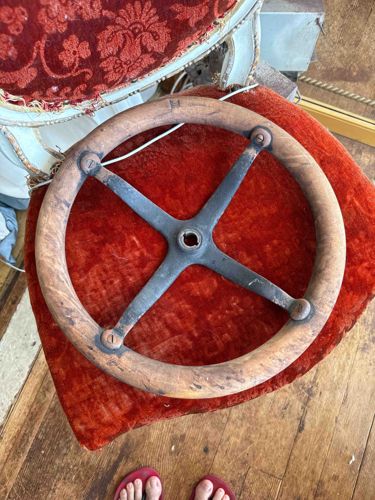
This appears to be an antique or vintage automotive steering wheel, likely for an early Ford vehicle, given the context. The wheel features a pronounced wooden rim, which exhibits a light to medium brown natural wood tone with visible grain patterns, indicative of a fine-grained hardwood. The wood shows significant signs of wear, including darkening, scuffs, and patches where the original finish has likely worn away, contributing to a rich patina from prolonged use and age. The construction involves a four-spoke design, with the spokes and central hub made of a dark-colored metal, appearing to be cast iron or steel. The metal components show a matte, aged finish, consistent with oxidation and possibly remnants of original paint. There are visible fasteners, likely rivets or bolts, securing the wooden rim to the metal spokes, indicating a robust, multi-component construction. The central hub has a splined or keyed opening, designed to mount onto a steering column shaft. No obvious manufacturer's marks or specific identifying features are discernible from the image, but its rustic, yet functional design, suggests an early 20th-century production, possibly 1910s to 1930s. The overall condition reflects its age and prior use, with no immediate signs of major structural damage, though the wear is extensive. The craftsmanship speaks to a period when automotive components were built for durability rather than modern aesthetics.
AI Appraisal Report
I have thoroughly examined the provided image and information regarding this Antique Wooden Ford Steering Wheel. This is a compelling piece of early automotive history, exhibiting the distinctive characteristics of a vintage Ford component. The wooden rim, with its visible grain and significant patina, strongly suggests genuine age and use. The four-spoke metal hub, likely cast iron or steel, shows appropriate wear and oxidation consistent with early 20th-century manufacturing. The robust construction, including visible fasteners, aligns with the durability focus of that era.
Based on visual assessment, the condition, while showing extensive wear including scuffs, darkening, and finish loss on the wood, appears structurally sound. This wear, in fact, enhances its antique appeal. Authenticity as an early Ford part is highly probable given the design and typical Ford characteristics of the period (1910s-1930s). However, without specific manufacturer markings, definitive attribution solely from images is challenging.
The market for vintage Ford parts is robust, driven by restorers and collectors. Comparables for Ford Model T or early Model A steering wheels, especially those with original wood, typically range. Demand remains steady for authentic, unrestored examples like this. The specific Model T era (1908-1927) would generally fetch higher values than early Model A (1928-1931).
Limitations exist in full authentication from images alone. An in-person examination would allow for tactile assessment of materials, weight, and detailed inspection for faint stampings or serial numbers. Provenance documentation, such as original vehicle history or sales records, would significantly enhance authentication. Scientific testing (e.g., wood dating or metal analysis) could provide definitive age confirmation but is typically unnecessary for this type of item unless significant value hinges on precise dating.
Factors impacting value include the precise Ford model it fits (Model T generally commands more), the degree of originality versus restoration, and the overall structural integrity. The extensive, authentic patina observed is a positive factor for collectors who prefer unrestored pieces.