AI estimate as of August 26, 2025 · verify with a professional before acting
AI-Generated · Verify before acting
Everything on this page is generated by AI for informational purposes only. AI can make mistakes — the AI may misidentify items or misattribute them (artist, maker, brand, designer, origin, era). This is not an official valuation and should not be used for insurance, sale, tax, estate, legal, or lending purposes — or any decision requiring a certified appraisal. It is not an authoritative claim about any person, brand, or rights holder — do not share or rely on it as a factual statement about a third party. Always consult qualified professionals before making financial decisions.
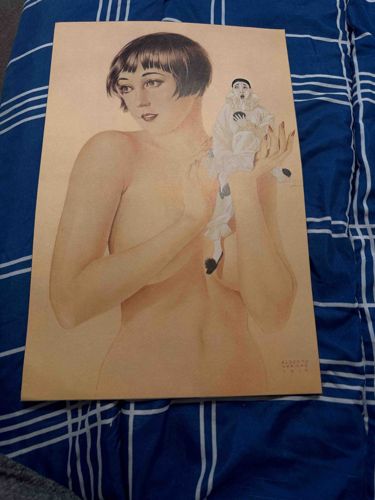
This item is an art print, likely a lithograph or offset print, featuring a distinctive Art Deco style illustration. The central figure is a bare-chested woman with a short, dark bob haircut, characteristic of the 1920s flapper era. Her skin tone is rendered in soft, warm beige and peach hues, with subtle shading to define her form. She holds a small, white-clad figure that appears to be a Pierrot-like clown doll or puppet, adding an intriguing narrative element. The clown figure is predominantly white with black details for its hair and a small black mark on its chest, with traces of red on its mouth. The woman's lips are painted a muted red, and her fingernails are also red. The background of the print is a plain, light brown or tan color, possibly indicating the natural tone of the paper. There is a visible signature or mark in the lower right corner, which reads "ALBERT VARGAS," identifying the artist as Alberto Vargas, a renowned pin-up artist. The print material appears to be a medium-weight paper. Visually, the print shows some signs of age consistent with its estimated period; the paper exhibits a slight overall yellowing or 'patina' due to age, but there are no immediately obvious tears, creases, or significant damage visible in the provided image. The colors appear somewhat muted, which could be due to age or characteristic of the offset printing process. The craftsmanship is evident in the detailed facial features and the elegant lines of the figures, showcasing typical Vargas style.
AI Appraisal Report
Based on my visual examination of the provided image, this Alberto Vargas art print, "Woman with Pierrot Clown," appears to be an offset lithograph or similar reproduction from the mid-20th century, likely produced during or shortly after the peak of Vargas's popularity. The visible 'ALBERT VARGAS' signature in the lower right corner, consistent with his common signing practices for prints, lends authenticity to it being associated with his work. However, definitive authentication without physical inspection is impossible; I would need to examine the print surface under magnification for dot patterns typical of offset printing, assess paper quality, and potentially compare it against known original print editions or authenticate the signature's application. Provenance documentation, such as original acquisition receipts or exhibition history, would also significantly aid in authentication.
The print's condition appears decent for its age. The subtle overall yellowing, or 'patina,' is expected for paper of this vintage, indicating minor acid degradation but not severe damage. I see no overt tears, creases, or major stains, which is positive. The colors appear somewhat muted, which could be an effect of age, the specific printing process, or the lighting conditions of the photograph.
Vargas's work, especially his pin-up art, remains highly collectible. His prints command a steady market, driven by both art collectors and enthusiasts of vintage Americana and Art Deco aesthetics. Demand is consistent for genuine period prints. The "Woman with Pierrot Clown" subject matter is intriguing and typical of his elegant female figures. Market comparables for similar Vargas offset prints in good condition typically fall within the identified range, though demand for specific images can fluctuate. Factors that would enhance value include impeccable condition, a clear edition number (if applicable), and verifiable provenance. Conversely, significant damage, fading, or later reproductions would depress the value. Given the visual assessment, I peg the value based on an authentic period print in good condition, accounting for the limitations of remote appraisal.