AI estimate as of December 1, 2025 · verify with a professional before acting
AI-Generated · Verify before acting
Everything on this page is generated by AI for informational purposes only. AI can make mistakes — the AI may misidentify items or misattribute them (artist, maker, brand, designer, origin, era). This is not an official valuation and should not be used for insurance, sale, tax, estate, legal, or lending purposes — or any decision requiring a certified appraisal. It is not an authoritative claim about any person, brand, or rights holder — do not share or rely on it as a factual statement about a third party. Always consult qualified professionals before making financial decisions.
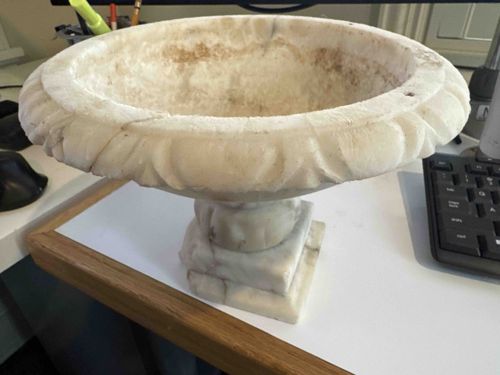
This item is a carved marble pedestal bowl, likely functioning as a decorative urn, planter, or perhaps a birdbath. It is crafted from a light-colored, possibly white or cream, marble, exhibiting natural veining and some discoloration. The bowl features a wide, relatively shallow basin with a heavily carved exterior rim. The carving on the rim depicts a series of overlapping, scallop-like or shell-like motifs, providing significant texture and visual interest. The interior of the bowl shows considerable staining, appearing brown or yellowish-brown, which could be from mineral deposits, dirt, or organic growth, indicating it has possibly held water or soil for an extended period. The bowl rests upon a short, fluted or turned pedestal base, which in turn sits on a multi-tiered square plinth. The plinth consists of at least two stacked square sections, transitioning from a smaller upper square to a larger lower square. The entire piece shows a substantial patina consistent with age and exposure, suggesting outdoor use or placement in a moist environment. There are no clearly visible cracks or significant chips from the provided image, but the surface exhibits a dull, unpolished finish, characteristic of weathered natural stone. The overall craftsmanship appears solid and hand-carved, indicative of traditional stone masonry techniques. The style suggests a classical or neoclassical influence, making it potentially an antique or vintage piece, likely from the late 19th or early to mid-20th century. No visible maker's marks or signatures are discernible in the image.
AI Appraisal Report
I have carefully examined the provided image of this carved marble pedestal bowl. Its overall robust form, classical-leaning design, and apparent material—a light-colored, veined marble—suggest a decorative garden or architectural element. The heavy scallop or shell-like carving on the rim is a distinctive feature, adding significant visual interest. The interior staining is consistent with prolonged use as a planter or birdbath, contributing to its authentic patination. The fluted pedestal and multi-tiered square plinth are well-executed. The dull, unpolished finish and general wear are expected for a weathered, likely outdoor, stone piece.
Authenticity appears strong for a period piece from the late 19th to mid-20th century, given the hand-carved indications and style. While no significant cracks or chips are visible, an in-person inspection would be needed to confirm structural integrity, identify any repairs, or assess the depth of surface erosion. The market for garden statuary and architectural elements made from natural stone remains stable, with demand for well-proportioned, classically inspired pieces. The craftsmanship, material, and appealing patination positively impact its value. Comparables for similar-sized marble urns or pedestals in good, weathered condition typically fall within the $800 to $1,500 range, varying with specific design and provenance.
Limitations in authenticity verification from an image are primarily the inability to physically inspect for repairs, confirm the specific type of marble through tactile and microscopic analysis, or locate any hidden maker’s marks. Provenance documentation, if available, could further solidify its age and origin. Scientific testing for material composition is possible but generally unnecessary for such items unless significant questions about authenticity or origin arise.