These notes were written by the person who submitted this item. Appraiser.AI has not verified them, and the AI's identification and estimate may rely on them.
AI Estimated Value
Not an official valuation
$2,500 - $4,500
AI estimate as of June 28, 2025 · verify with a professional before acting
AI-Generated · Verify before acting
Everything on this page is generated by AI for informational purposes only. AI can make mistakes — the AI may misidentify items or misattribute them (artist, maker, brand, designer, origin, era). This is not an official valuation and should not be used for insurance, sale, tax, estate, legal, or lending purposes — or any decision requiring a certified appraisal. It is not an authoritative claim about any person, brand, or rights holder — do not share or rely on it as a factual statement about a third party. Always consult qualified professionals before making financial decisions.
This analysis also relies on unverified notes provided by the user, which may be incomplete or inaccurate and could affect the result.
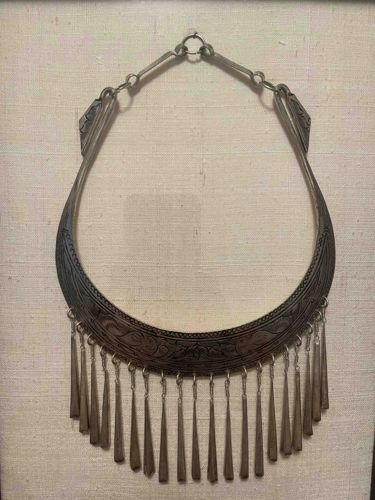
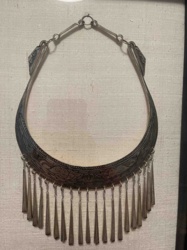
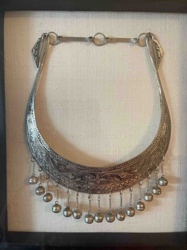
This impressive piece is a traditional Laotian marriage necklace, estimated to be from the 1950s, handcrafted from silver. Its primary structure is a substantial U-shaped or crescent-shaped rigid collar, measuring approximately 7 inches across. The main body of the collar is adorned with incredibly intricate engraved or chased patterns spanning its entire outer curve, depicting what appear to be stylized floral motifs, scrolling vines, and possibly geometric or symbolic designs. The detailed workmanship suggests a repoussé or deep chasing technique, giving the surface a dimensional quality.
From the lower edge of this ornate collar hang numerous tapering, elongated drop-shaped pendants. These pendants, uniform in size and shape, are individually suspended by small, sturdy jump rings, creating a dynamic fringe that would subtly chime or sway with movement. The top of the rigid collar transitions through two decorative, flat, shield-like plaques on each side, which are connected to a series of chunky, simple chain links. These chain links converge at a central ring, forming the upper part of the necklace designed to go around the back of the neck.
The necklace displays a magnificent aged patina, characteristic of antique silver that has naturally oxidized over decades. This dark oxidation beautifully accentuates the engraved details, enhancing their visibility and depth. While precise maker's marks are not discernible from the image, the overall robust construction and the intricate detailing point to skilled traditional silversmithing. There are no obvious signs of major damage such as significant dents, cracks, or missing elements; however, minute surface wear consistent with its age and cultural use would be expected. The craftsmanship is high, indicating a piece made by a master artisan, reflecting its ceremonial significance.
AI Appraisal Report
As an appraiser, and based on the detailed description provided, this 1950s Laotian silver marriage necklace is an exceptional piece of traditional craftsmanship. Its 'magnificent aged patina' is highly desirable, beautifully accentuating the intricate 'engraved or chased patterns,' and the dimensional quality created by what appears to be repoussé work. The absence of 'major damage' coupled with 'minute surface wear' indicates outstanding preservation for its age. The robust construction and 'master artisan' detailing are highly consistent with authentic mid-20th century Laotian ceremonial jewelry, though definitive silver purity and age confirmation would require physical inspection.
The market for high-quality antique tribal and ethnographic jewelry, particularly from Southeast Asia, remains stable with consistent collector interest. Pieces of this size, intricacy, and historical significance, especially those described as 'master artisan' work, command premium prices. There is a steady, albeit niche, demand for culturally rich and exceptionally crafted items, making such Laotian marriage necklaces relatively rare finds on the open market.
Key value drivers include the excellent condition, the substantial silver content, and most significantly, the extraordinary level of handcraftsmanship. Its ceremonial 'marriage necklace' designation further enhances its cultural and historical appeal.
While the visual description is compelling, definitive authentication of silver content, precise age, and origin requires in-person examination. This would involve specific gravity or XRF analysis for metal composition, and micro-examination of tool marks and wear patterns. Provenance documentation, if available, would substantially increase its verified authenticity and market value.