AI estimate as of September 2, 2025 · verify with a professional before acting
AI-Generated · Verify before acting
Everything on this page is generated by AI for informational purposes only. AI can make mistakes — the AI may misidentify items or misattribute them (artist, maker, brand, designer, origin, era). This is not an official valuation and should not be used for insurance, sale, tax, estate, legal, or lending purposes — or any decision requiring a certified appraisal. It is not an authoritative claim about any person, brand, or rights holder — do not share or rely on it as a factual statement about a third party. Always consult qualified professionals before making financial decisions.
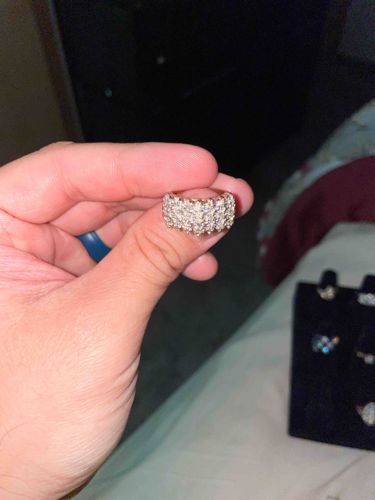
The item is a wide band ring, likely crafted from a white metal such as sterling silver, white gold, or platinum, given its bright, reflective appearance. The entire visible surface of the ring's band is densely covered with numerous small, round brilliant cut stones, set closely together in what appears to be a pave or micro-pave style. These stones are clear and highly reflective, suggesting they are diamonds or high-quality diamond simulants. The setting technique creates a continuous, glittering surface with minimal visible metal between the stones, maximizing their sparkle. The ring's band is quite broad, possibly indicating a multi-row setting or a substantial design. No specific maker's marks or hallmarks are discernible from the image. The overall condition appears good, with no obvious missing stones or significant damage, though a closer inspection would be needed to confirm stone security and metal integrity. The style suggests a contemporary design, possibly from the late 20th or 21st century, often referred to as an 'eternity band' or 'statement ring' due to its full stone coverage. The craftsmanship appears to be of good quality, given the intricate stone setting.
AI Appraisal Report
Based on my visual examination of the provided image, this is a wide band ring densely set with numerous small, round brilliant cut stones in a pave or micro-pave style. The bright, reflective appearance of the metal suggests white gold or platinum, though sterling silver is also a possibility. The stones are clear and highly reflective, indicating they are either diamonds or high-quality diamond simulants. The overall condition appears good; all stones are present, and there are no visible signs of significant damage. The craftsmanship, particularly the intricate pave setting, seems to be of good quality.
Market conditions for pave-set rings are generally strong, especially for pieces with genuine diamonds and precious metals. Comparables for similar bands set with excellent quality diamond simulants can range from a few hundred dollars, while those with natural diamonds, even small ones, could easily fetch several thousand, depending on the cumulative carat weight and quality. The demand for such a full-coverage, sparkling design remains consistently high.
Factors significantly impacting value include the actual material of the stones (diamond vs. stimulant) and the metal. Without physical inspection, it is impossible to definitively determine if the stones are diamonds or simulants, which is the primary variable in the valuation. Similarly, the specific metal (sterling silver, white gold, or platinum) cannot be confirmed visually. If the metal is sterling silver with cubic zirconia, the value would be at the lower end of the range. If it is 14k or 18k white gold with small, natural diamonds, the value would be at the higher end, possibly exceeding $1,200.
To provide a definitive authentication and valuation, an in-person examination is crucial. This would allow for: 1) testing the stones with a diamond tester to determine their authenticity, 2) assessing the metal's purity and composition through hallmark inspection or testing, and 3) a detailed examination of the setting integrity and overall piece for any hidden flaws. Provenance documentation, if available, would also aid in verifying the history and composition of the materials.