AI estimate as of August 9, 2025 · verify with a professional before acting
AI-Generated · Verify before acting
Everything on this page is generated by AI for informational purposes only. AI can make mistakes — the AI may misidentify items or misattribute them (artist, maker, brand, designer, origin, era). This is not an official valuation and should not be used for insurance, sale, tax, estate, legal, or lending purposes — or any decision requiring a certified appraisal. It is not an authoritative claim about any person, brand, or rights holder — do not share or rely on it as a factual statement about a third party. Always consult qualified professionals before making financial decisions.
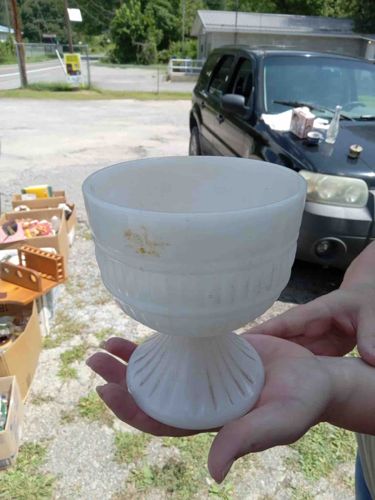
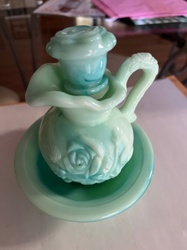
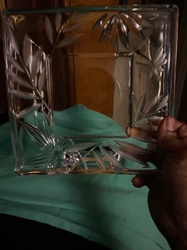
This item is a Milk Glass Footed Bowl or Compote, made from opaque white glass, characteristic of milk glass from the late 19th to mid-20th century. It features a rounded bowl top supported by a flared, footed base. The bowl's exterior is adorned with a decorative band showcasing a repeating pattern of vertical flutes or ridges, hinting at a classical or early American design influence. Below this band, the bowl transitions into a smooth, slightly tapered section. The base is notably prominent, with radial fluting extending upwards from the perimeter, creating a ribbed effect that mirrors the decor on the upper bowl. The overall construction appears robust, typical of pressed glass manufacturing methods of the era. The color is a solid, consistent opaque white. Visible condition issues include what appears to be a light brown or yellowish stain on the interior upper rim of the bowl, suggesting either residue from previous use, discoloration from age, or environmental exposure. There are no readily discernible maker's marks, signatures, or stamps from the provided image, which is common for many mass-produced milk glass items. The design and material suggest it could date from the Victorian era through the mid-20th century. The craftsmanship, while not intricate, is indicative of durable, functional glassware intended for everyday use or simple decoration, with the molded patterns adding a touch of elegance. Its unique aspect lies in its material and the classic, timeless design that has remained popular for decades.
AI Appraisal Report
I have examined the provided image of this Milk Glass Footed Bowl/Compote. Visually, the piece presents as authentic milk glass, likely dating from the late 19th to mid-20th century, consistent with the described manufacturing and design characteristics. The opaque white color and pressed glass construction are typical. Its condition, as observed in the image, shows a noticeable light brown/yellowish stain on the interior upper rim. This discoloration, whether from residue, age, or environmental factors, negatively impacts the aesthetic appeal and, consequently, its market value. While minor chips or cracks cannot be completely ruled out without a physical inspection, none are apparent in the image.
From a market perspective, milk glass is a common collectible, and while decorative, many pieces are not exceedingly rare unless they possess unique patterns, colors, or manufacturer marks. This particular design, with its vertical and radial fluting, is relatively common among pressed glass patterns of the era. Demand for common milk glass pieces is moderate, primarily from collectors of vintage kitchenware and decorative arts, or individuals seeking specific design styles. The lack of discernible maker's marks is typical for many mass-produced items and does not inherently diminish authenticity but limits specific attribution to a renowned manufacturer, which could increase value. The staining is the most significant factor impacting its present value.
To fully authenticate and assess this piece, a physical in-person examination would be crucial. This would allow for a thorough inspection for chips, cracks, and restoration work not visible in the image. Proper identification of the stain would also be possible to determine if it is removable. Furthermore, physical examination could potentially uncover faint maker's marks, and spectroscopy or other scientific testing could verify the glass composition and age with greater precision. Provenance documentation, if available, would also significantly enhance its value by establishing its history and origin. Without these, the appraisal remains based on visual assessment alone.