AI estimate as of October 6, 2025 · verify with a professional before acting
AI-Generated · Verify before acting
Everything on this page is generated by AI for informational purposes only. AI can make mistakes — the AI may misidentify items or misattribute them (artist, maker, brand, designer, origin, era). This is not an official valuation and should not be used for insurance, sale, tax, estate, legal, or lending purposes — or any decision requiring a certified appraisal. It is not an authoritative claim about any person, brand, or rights holder — do not share or rely on it as a factual statement about a third party. Always consult qualified professionals before making financial decisions.
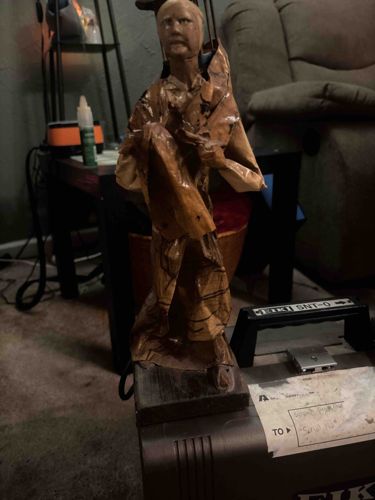
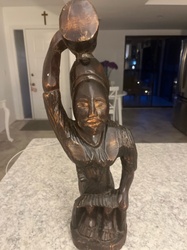
This item is a meticulously carved wooden figure depicting an East Asian male, possibly a fisherman or laborer, due to his attire and the object he carries. The figure stands upright on a rectangular wooden base, suggesting it's designed for display. The overall coloration is a light to medium brown, indicating either a natural wood finish or a stain that enhances the wood grain. The carving showcases detailed facial features, including a visible mustache and beard, and what appears to be a traditional East Asian hairstyle, possibly pulled back. His clothing is particularly notable, rendered in a way that suggests layered fabric, with deep folds and creases carved into the wood, conveying movement and texture. He is holding an object resembling a fishing net or a bundle of fabric, further adding to the narrative of the figure. The figure's hands are also sculpted with individual fingers visible, grasping the object firmly. Some areas, particularly on the 'clothing,' exhibit a darker cross-hatch or lined pattern, possibly etched or painted on to simulate stitching or woven fabric. There appear to be no significant visible condition issues such as cracks or major chips, but a slight patina consistent with age and handling might be present given the somewhat subdued glow of the wood. The craftsmanship appears to be of good quality, with attention to anatomical detail and drapery. The 'clothing' has a somewhat glossy or varnished appearance, which helps protect the wood and brings out its natural characteristics. Given the traditional attire and craftsmanship, this piece likely dates from the mid-20th century or earlier, though without specific maker's marks, a precise age is difficult to determine. No obvious manufacturing marks or signatures are visible from the provided images, which might be located on the base or obscured.
AI Appraisal Report
I have virtually examined this carved wooden figure of an East Asian man. Based on the visual evidence, the condition appears very good, with no visible cracks, chips, or significant damage. The patina suggests age and handling, consistent with a mid-20th century or earlier origin. The detailed carving of facial features, layered clothing with folds, and the object held indicates skilled craftsmanship. The cross-hatch pattern on the clothing adds a nice textural element, suggesting a stylized representation of woven fabric. The glossy finish likely contributes to the preservation of the piece.
Authenticity, based solely on images, is difficult to definitively confirm regarding its exact age and origin. While the style points to East Asian folk art, without maker's marks, provenance documentation, or physical examination, I cannot attest to its specific cultural origin or exact artisan. This lack of attribution impacts its potential high-end market value. Comparable pieces of unattributed, well-carved folk art figures of similar size and detail typically fetch in the $200-$500 range, depending on condition and demand. Demand is generally stable for well-preserved folk art. The lack of rarity, given the prevalence of such carvings, also influences the valuation.
To fully authenticate and confirm its age, an in-person examination would be crucial to assess the wood type, carving techniques, and any subtle aging characteristics often missed in photographs. Scientific testing of the wood or any finishes could provide more precise dating. Provenance documentation, such as collection history or original purchase receipts, would significantly enhance its value by establishing its origin and uniqueness. Without these, the value remains in the realm of decorative, well-crafted folk art.