AI Appraisal Estimate

AI-generated estimates · not official valuations

From the user

What was submitted

Photo and notes provided by the user — not generated by AI

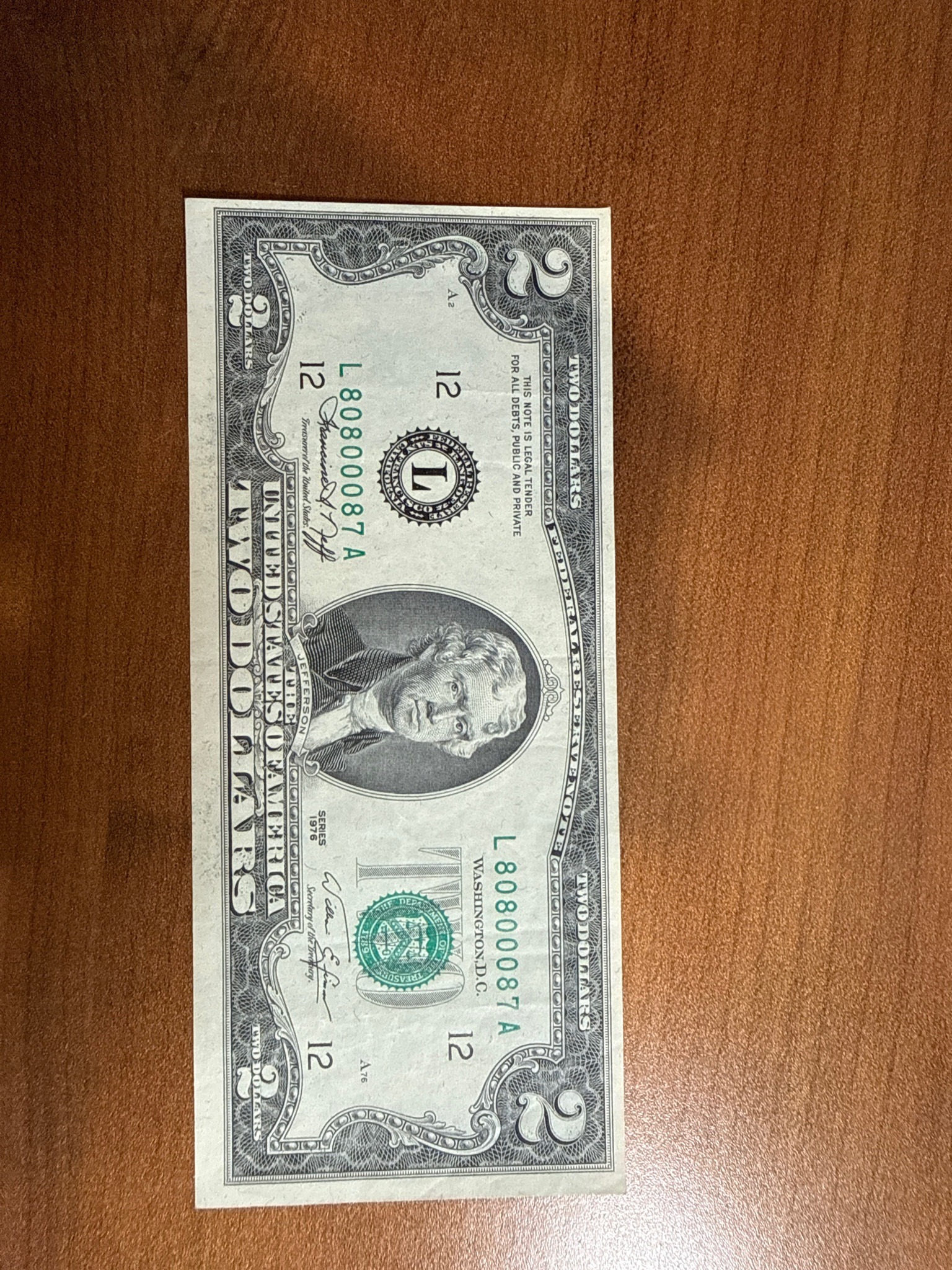
Submitted item photo
Submitted photo · May 30, 2026

User's notes

No additional notes provided.

AI analysis below

AI appraisal

AI analysis & estimate

AI-Generated · Verify before acting

Everything below is generated by AI for informational purposes only. AI can make mistakes — the AI may misidentify items or misattribute them (artist, maker, brand, designer, origin, era). This is not an official valuation and should not be used for insurance, sale, tax, estate, legal, or lending purposes — or any decision requiring a certified appraisal. It is not an authoritative claim about any person, brand, or rights holder — do not share or rely on it as a factual statement about a third party. Always consult qualified professionals before making financial decisions.

Read the full disclaimer

AI Identification

·Not independently authenticated·Verify before acting

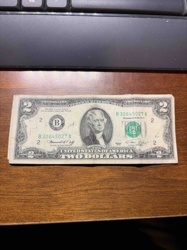
Series 1976 United States Two-Dollar Federal Reserve Note

Numismatics / US Paper Currency

AI Estimated Value

·Not an official valuation·Verify before acting

$5.00 - $8.00

As of May 30, 2026

AI Item Analysis

·AI can make mistakes·Verify before acting
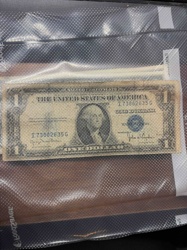
This is a Series 1976 United States $2 bill, a commemorative issue released for the U.S. Bicentennial. The note features a portrait of Thomas Jefferson on the obverse, rendered in a fine intaglio engraving style characteristic of U.S. currency. It displays distinct green serial numbers (L 80800087 A) and a matching green Treasury Department seal on the right side. On the left, a black Federal Reserve Bank of San Francisco (District 12) seal is prominently featured. The signatures of Francine I. Neff and William E. Simon appear on the bottom. The currency is printed on high-quality crane paper containing characteristic tiny red and blue silk security fibers. Physically, the bill appears to be in remarkably crisp, Extremely Fine to About Uncirculated condition, showing very sharp corners and no heavy vertical folds. There is a slight visible wave to the paper, suggesting it has been handled but not heavily circulated. The ink remains dark and well-defined against the off-white paper stock. The centering appears slightly shifted toward the bottom margin, which is a common manufacturing variance but notable for numismatic grading. This piece carries historical significance as the first year the $2 bill was redesigned to include the Declaration thinner engraving on the reverse (though not visible here).
AI Appraisal Report

·AI can make mistakes·Verify before acting
I have examined the digital representation of this Series 1976 $2 Federal Reserve Note. Based on visual analysis, the note appears to be authentic, exhibiting the correct intaglio printing characteristics, sharp engraving details for the San Francisco district, and the expected presence of security fibers. The condition is a strong 'About Uncirculated' (AU-58). The corners remain exceptionally crisp and the ink saturation is deep; however, the slight paper wave and minor centering shift toward the bottom margin prevent a higher Gem Uncirculated grade. From a market perspective, the 1976 series was printed in massive quantities (over 590 million notes) to celebrate the Bicentennial. Consequently, they are not rare. While they carry significant nostalgic and historical value as the first year of the modern $2 design, they are common in high-grade conditions. Comparable sales for an unmounted, non-star note from the San Francisco district in this condition typically range between two to four times the face value. Factors such as the serial number (L 80800087 A) are nearly 'fancy' but do not provide a significant premium as they are not a true radar or low-digit sequence. Limitations: Digital examination cannot verify the physical 'snap' of the paper or detect subtle chemical cleaning. A full authentication would require an in-person inspection under UV light and high-magnification microscopy to confirm the paper texture and ink depth. For maximum market realization, professional grading by PMG or PCGS would be required, though the cost of grading may exceed the note's increased value.

Get your items appraised

Instant estimates of your treasures with AI-powered appraisals

Browse More Appraisals