These notes were written by the person who submitted this item. Appraiser.AI has not verified them, and the AI's identification and estimate may rely on them.
AI Estimated Value
Not an official valuation
$40-70
AI estimate as of July 10, 2025 · verify with a professional before acting
AI-Generated · Verify before acting
Everything on this page is generated by AI for informational purposes only. AI can make mistakes — the AI may misidentify items or misattribute them (artist, maker, brand, designer, origin, era). This is not an official valuation and should not be used for insurance, sale, tax, estate, legal, or lending purposes — or any decision requiring a certified appraisal. It is not an authoritative claim about any person, brand, or rights holder — do not share or rely on it as a factual statement about a third party. Always consult qualified professionals before making financial decisions.
This analysis also relies on unverified notes provided by the user, which may be incomplete or inaccurate and could affect the result.
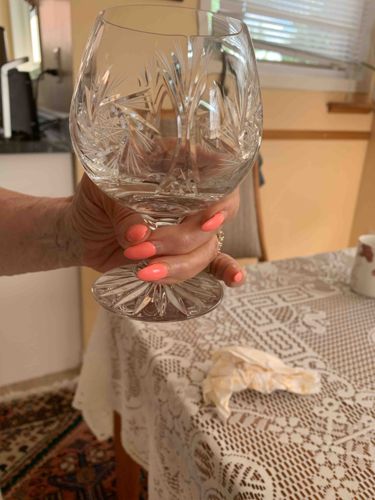
This is a clear, highly refractive glass, likely lead crystal, in the form of a brandy snifter or stemmed cordial glass. The vessel features a balloon-shaped bowl, typical for concentrating aromas. The primary decorative element is an intricate cut glass pattern, exhibiting a radiant starburst design on the base of the bowl and extending upwards with feathered, fan-like cuts and cross-hatching. These cuts are deep and well-defined, suggesting high-quality hand-cutting, which contributes to the item's sparkle. The stem is short and thick, connecting the bowl to a circular foot which also displays a corresponding starburst pattern, echoing the design on the bowl's bottom. The rim appears smoothly finished, without chips or cracks, indicating good preservation. No visible maker's marks or signatures are discernable from the provided image. The overall craftsmanship suggests a mid-20th century to contemporary period, possibly from a European manufacturer known for traditional cut crystal. The clarity and brilliance of the glass indicate a high lead content, characteristic of quality crystal production. There are no obvious signs of significant wear or damage, such as large scratches, chips, or cloudiness, suggesting it has been well-maintained. The item's proportions are well-balanced, contributing to its aesthetic appeal and user comfort.
AI Appraisal Report
Based on my visual examination of the provided image, this Cut Crystal Brandy Snifter presents as a high-quality piece of drinkware. The clarity and brilliance, coupled with the deeply cut starburst, feathered, and cross-hatch patterns, strongly suggest it is indeed lead crystal. The craftsmanship appears excellent, with well-defined cuts that contribute significantly to its refractive properties and visual appeal. I assess its condition as very good to excellent; no chips, cracks, or cloudiness are apparent from the image, and the rim is smooth. The design is classic and timeless, indicative of traditional European crystal manufacturing.
In terms of market conditions, demand for finely cut crystal glassware remains steady, especially for distinctive pieces. While not exceptionally rare, quality unbranded cut crystal from the mid-20th century, like this snifter, holds value. Factors positively impacting value include its excellent condition, probable lead content, and detailed hand-cutting. The absence of a maker's mark, however, limits its value compared to pieces from renowned manufacturers like Baccarat or Waterford, as brand recognition significantly boosts collectibility and price.
Authenticity verification from images alone presents limitations. While the visual indicators are strong, a definitive authentication would require an in-person examination to assess the glass's precise weight, specific gravity (to confirm lead content), feel of the cuts, and to search for any faint or hidden marks. Provenance documentation, if available, would also be crucial. For full authentication and to ascertain the exact manufacturer and period, scientific testing for lead content and microscopic analysis of cutting techniques might be employed.