These notes were written by the person who submitted this item. Appraiser.AI has not verified them, and the AI's identification and estimate may rely on them.
AI Estimated Value
Not an official valuation
$250-400
AI estimate as of December 15, 2025 · verify with a professional before acting
AI-Generated · Verify before acting
Everything on this page is generated by AI for informational purposes only. AI can make mistakes — the AI may misidentify items or misattribute them (artist, maker, brand, designer, origin, era). This is not an official valuation and should not be used for insurance, sale, tax, estate, legal, or lending purposes — or any decision requiring a certified appraisal. It is not an authoritative claim about any person, brand, or rights holder — do not share or rely on it as a factual statement about a third party. Always consult qualified professionals before making financial decisions.
This analysis also relies on unverified notes provided by the user, which may be incomplete or inaccurate and could affect the result.
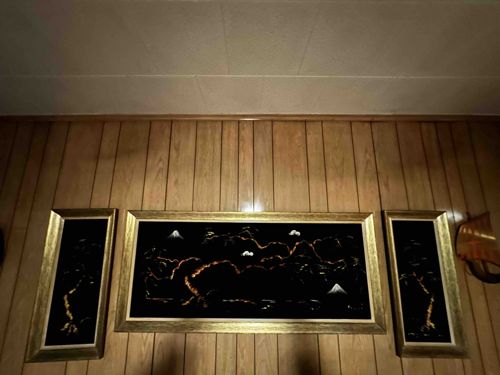
This is a three-piece set of framed artworks, commonly referred to as felt oil paintings from the mid-20th century, specifically the 1950s based on the context. The central piece is a large horizontal painting, flanked by two smaller vertical panels. Each painting features an opaque black background against which a landscape scene is depicted. The dominant colors in the artwork itself appear to be shades of white, gold, and deep orange/red, creating a striking contrast with the black. The style evokes traditional Asian landscape painting, often featuring stylized mountains, clouds, and organic forms that could represent trees or flowing earthworks. The 'felt' aspect likely refers to the technique where oil paints are applied to a felt or velvet surface, which can give the colors a rich, matte finish and distinct texture. The visible brushstrokes or application technique appear to create a somewhat abstract yet recognizable mountainous landscape. The paintings are housed in frames that appear to be made of wood with a gilded or gold-painted finish, possibly some form of gessoed and gilded composite material. The frames have a simple, flat profile with a slightly recessed inner edge, typical of mid-century framing. The condition appears to be good for its age, though specific wear or damage is hard to discern from the low-resolution image. The glint on the frames could indicate some wear to the gilding or simply reflection of light. There are no discernible artist signatures or manufacturer marks from the image provided. These pieces likely served as decorative wall art, reflecting a popular aesthetic of the era that blended exotic influences with accessible home decor.
AI Appraisal Report
Based on my visual examination of the provided image, this Vintage Felt Oil Painting Triptych, described as Hawaiian/Asian Style Landscape and dated to the 1950s, appears to be an authentic example of popular mid-century decorative art. The 'felt oil painting' technique, often involving oils applied to velvet or felt, was prevalent during this era, offering a distinct textural quality and vibrant color contrast against dark backgrounds. The stylistic elements, with stylized mountains and organic forms, align well with the exotic influences popular in 1950s home decor, often blending Asian aesthetics with a generalized ‘tropical’ feel. I assess the condition to be good for its age. The frames, likely gilded wood or a composite material, show typical mid-century styling. While some glinting suggests possible wear to the gilding, this is common and does not significantly detract from its decorative appeal from this distance.
Market conditions for this specific type of decorative art are moderate. While there's a steady interest in mid-century modern and vintage decor, general 'felt oil paintings' are not typically high-value fine art pieces. Comparables indicate that decorative triptychs from this period, especially those with an appealing aesthetic and in good condition, generally command values in the low to mid-hundreds. Demand for such pieces is driven primarily by their decorative value and nostalgic appeal rather than artistic merit or provenance. Rarity is not a significant factor here, as similar decorative art was mass-produced, though a well-preserved triptych set is less common than individual pieces.
Factors impacting value include the attractive composition, the complete triptych format, and the presumed good condition. However, the lack of an identifiable artist or specific provenance limits its value as collectible fine art.
It is crucial to note the limitations of authenticity verification from images alone. Without physical inspection, I cannot confirm the exact medium (e.g., true oil on felt vs. a print designed to mimic this style), the structural integrity of the frames, or detect subtle damage to the canvas or paint surface that might impact value. For full authentication, an in-person examination would be needed to verify the painting technique, assess the actual condition of both the art and frames, and search for hidden artist signatures or manufacturer marks. Provenance documentation, if available, would also be invaluable.