These notes were written by the person who submitted this item. Appraiser.AI has not verified them, and the AI's identification and estimate may rely on them.
AI Estimated Value
Not an official valuation
$1,200 - $1,700
AI estimate as of June 28, 2025 · verify with a professional before acting
AI-Generated · Verify before acting
Everything on this page is generated by AI for informational purposes only. AI can make mistakes — the AI may misidentify items or misattribute them (artist, maker, brand, designer, origin, era). This is not an official valuation and should not be used for insurance, sale, tax, estate, legal, or lending purposes — or any decision requiring a certified appraisal. It is not an authoritative claim about any person, brand, or rights holder — do not share or rely on it as a factual statement about a third party. Always consult qualified professionals before making financial decisions.
This analysis also relies on unverified notes provided by the user, which may be incomplete or inaccurate and could affect the result.
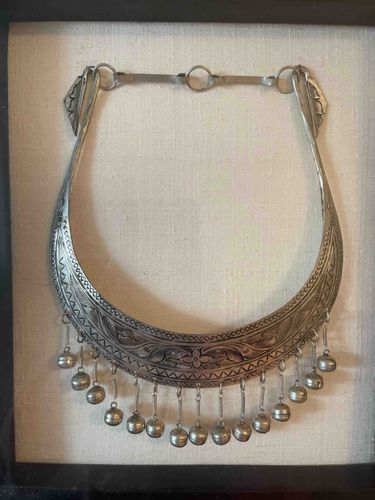
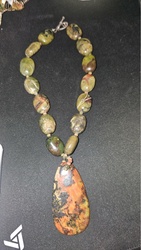
This is a traditional Laotian silver marriage necklace, a distinctive piece of ethnic jewelry dating from the 1950s. The necklace features a prominent, robust crescent or collar-shaped main body, crafted from what appears to be silver or a high-silver content alloy. It exhibits a rich, dark patina consistent with aged silver, enhancing its antique character and suggesting its historical provenance. The main body, approximately 6 inches across, is elaborately decorated with intricate repoussé or chased patterns. These designs include a central band showcasing stylized floral or botanical motifs, bordered on both the upper and lower edges by precise geometric patterns. The upper rim of the crescent is further adorned with a finely serrated or scalloped border, adding a delicate finish. Suspended from the lower edge of the main body are numerous uniformly shaped, bell-like pendants, each attached by a small link, designed to create subtle movement and sound. The terminals of the crescent ascend and elegantly curve outwards, ending in decorative, possibly leaf-inspired elements, which connect via simple rings to a rigid, two-part bar-and-ring closure. The craftsmanship is high, evident in the detailed and consistent engraving work and the symmetrical formation of the multiple hanging bells, indicating traditional silversmithing techniques. The piece appears to be in good antique condition, with no obvious major damage, dents, or apparent repairs; the existing wear and natural patina are consistent with its age and contribute significantly to its authentic charm. This necklace represents a significant cultural artifact, likely used in traditional Laotian ceremonies or as a symbolic piece of status.
AI Appraisal Report
Upon examining the detailed description of this 1950s Laotian Silver Marriage Necklace, I find it to be a compelling example of traditional ethnic jewelry. The reported characteristics—a prominent crescent-shaped body, rich dark patina, and intricate repoussé and chased patterns featuring stylized floral and geometric motifs—are consistent with authentic Laotian silversmithing of the mid-20th century. The description of uniformly shaped bell-like pendants and a robust bar-and-ring closure, along with the 6-inch width, further supports its authenticity, substantial nature, and traditional craftsmanship. The condition appears to be good antique, with wear and natural patina consistent with its age, contributing to its authentic charm. Significantly, there are "no obvious major damage, dents, or apparent repairs," which positively impacts its value.
In terms of market conditions, antique ethnic tribal jewelry from Southeast Asia like this piece commands a dedicated collector's market. Comparables include similar silver necklaces from Laos, Thailand, or Myanmar found in specialized galleries or ethnographic auctions. Demand for well-preserved, culturally significant pieces is stable. Factors positively impacting its value are its age, apparent good condition, artistic merit through intricate details, and its cultural significance as a marriage necklace.
However, limitations exist without a physical examination. I cannot definitively verify the precise silver purity without XRF or touchstone testing, nor can I rule out subtle structural issues or hidden repairs that are not visible in images. Confirmation of the "1950s" dating relies on stylistic analysis; an in-person assessment of tool marks, construction, and patina, along with provenance documentation, would offer more conclusive proof. Despite these limitations regarding definitive verification, based on the comprehensive description, this necklace is highly desirable.