These notes were written by the person who submitted this item. Appraiser.AI has not verified them, and the AI's identification and estimate may rely on them.
AI Estimated Value
Not an official valuation
$40-$65
AI estimate as of July 26, 2025 · verify with a professional before acting
AI-Generated · Verify before acting
Everything on this page is generated by AI for informational purposes only. AI can make mistakes — the AI may misidentify items or misattribute them (artist, maker, brand, designer, origin, era). This is not an official valuation and should not be used for insurance, sale, tax, estate, legal, or lending purposes — or any decision requiring a certified appraisal. It is not an authoritative claim about any person, brand, or rights holder — do not share or rely on it as a factual statement about a third party. Always consult qualified professionals before making financial decisions.
This analysis also relies on unverified notes provided by the user, which may be incomplete or inaccurate and could affect the result.
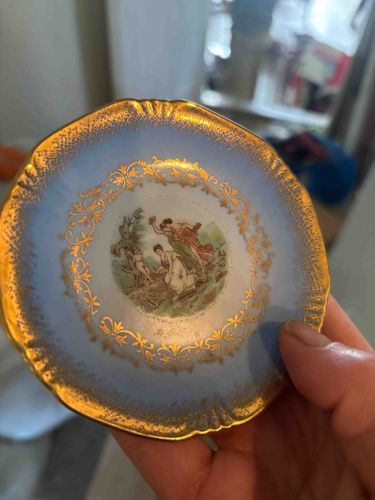
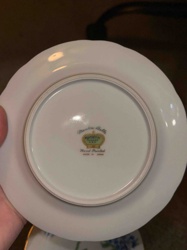
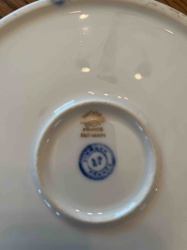
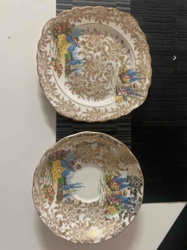
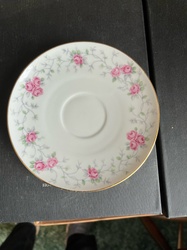
This item is a small decorative plate or saucer, likely made of porcelain or fine bone china, given its delicate appearance and intricate decoration. The primary color of the plate's face is a soft, light blue, possibly described as periwinkle or baby blue. It features a prominent central medallion with a multi-figure transfer-printed or hand-painted scene, depicting classical or mythological figures in what appears to be a pastoral setting. The figures are rendered with noticeable detail in various shades, including flesh tones, greens for foliage, and earthy browns, suggesting an idyllic or romanticized narrative. Surrounding this central scene is an elaborate gold rococo-style border, characterized by scrolling foliate motifs and intricate flourishes. A similar, broader band of gold decoration, also in a rococo or Baroque revival style, encircles the outer rim of the plate. The rim itself is scalloped or fluted, adding to its ornamental quality, and is heavily gilded along the edge, creating a rich contrast with the light blue ground. The gold appears to be in good condition with minor signs of wear or rubbing, consistent with age and occasional handling, but no significant loss is visible. The porcelain surface exhibits a soft sheen, typical of glazed ceramics. No specific maker's marks or signatures are visible from the provided images, but the 'Made in Germany' context suggests it is of German origin. Based on its style, particularly the rococo ornamentation and classical figural scene, this piece likely dates from the late 19th to early 20th century, a period when such decorative wares were popular. Its small size suggests it might be a cabinet plate, a miniature dish, or part of a demitasse cup and saucer set. The craftsmanship appears to be of high quality, indicative of a reputable porcelain manufacturer. There are no obvious chips, cracks, or repairs visible in the provided image.
AI Appraisal Report
Upon visual examination of the provided imagery, this German porcelain decorative plate presents as a fine example of late 19th or early 20th-century production. The piece is in excellent condition, with no visible chips, cracks, or repairs. The light blue ground provides a beautiful contrast to the elaborate rococo-style goldwork and the classical figural scene, which appears to be a high-quality transfer print with possible hand-painted details. The gilding is largely intact, showing only minor wear consistent with its age, which does not significantly detract from its appeal. The 'Made in Germany' mark places its origin, but without a specific manufacturer's mark (e.g., Meissen, KPM, Rosenthal), its value is primarily determined by its decorative quality rather than its pedigree. The market for such cabinet plates is stable, with consistent demand from decorators and collectors of German porcelain. Comparables from respected but not top-tier German factories of this era typically sell in this range. The primary factor limiting its value is the lack of a specific maker attribution. A positive identification from a renowned manufacturer could increase its value considerably. It is important to note that a definitive appraisal of authenticity and condition requires in-person examination to assess the quality of the porcelain, verify the method of decoration (hand-painted vs. transfer), and search for any hidden maker's marks or faint impressions on the underside. Full authentication would benefit from this physical inspection.