AI identification & appraisal estimate

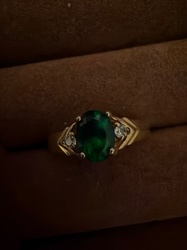
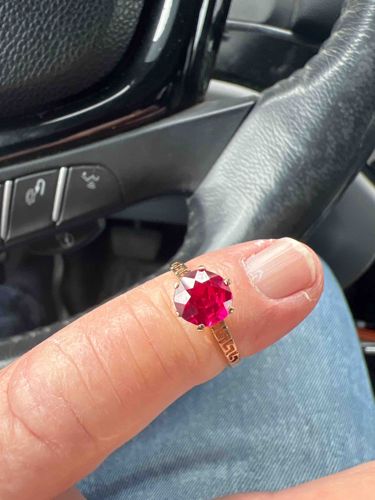
14k Gold Round Cut Ruby Solitaire Ring with Greek Key Motif

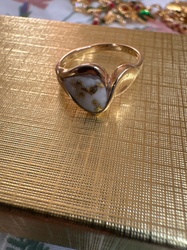
Submitted photo of 14k Gold Round Cut Ruby Solitaire Ring with Greek Key Motif
Photo submitted by the user — not generated by AI

User's notes

1 1/2 c center stone 14k

These notes were written by the person who submitted this item. Appraiser.AI has not verified them, and the AI's identification and estimate may rely on them.

AI Estimated Value

Not an official valuation

$400 - $800

AI estimate as of February 28, 2026 · verify with a professional before acting

AI-Generated · Verify before acting

Everything on this page is generated by AI for informational purposes only. AI can make mistakes — the AI may misidentify items or misattribute them (artist, maker, brand, designer, origin, era). This is not an official valuation and should not be used for insurance, sale, tax, estate, legal, or lending purposes — or any decision requiring a certified appraisal. It is not an authoritative claim about any person, brand, or rights holder — do not share or rely on it as a factual statement about a third party. Always consult qualified professionals before making financial decisions.

This analysis also relies on unverified notes provided by the user, which may be incomplete or inaccurate and could affect the result.

Read the full disclaimer

AI Item Analysis

This is a solitaire statement ring featuring a large, vibrant round-cut red gemstone, identified by the user as a 1.5-carat center stone. The gem exhibits a deep pigeon-blood red hue with visible brilliance and is secured in a classic six-prong setting. The mounting is crafted from 14k yellow gold, characterized by a unique and decorative shank. The shoulders of the ring are embellished with an open-work Greek Key (meander) motif, which adds a classical or Mediterranean stylistic influence to the piece. The band narrows toward the back and appears to have a polished finish. In terms of condition, the prongs appear intact and well-aligned, though the gemstone's surface should be inspected under magnification for any facet wear or abrasions common with older pieces. The metal shows minor signs of surface wear consistent with light use. The craftsmanship is notable for the precision of the cast geometric pattern on the shank. While internal hallmarks are not visible in the photo, the provided context indicates a 14k gold purity. The style suggests a late 20th-century vintage aesthetic, possibly from the 1980s or 1990s when bold gemstone solitaires and geometric motifs were prevalent in jewelry design.
AI Appraisal Report

Based on a visual examination of the provided images, this ring presents as a vintage-style solitaire featuring a prominent round-cut red gemstone, stated to be 1.50 carats, set in 14k yellow gold. The setting is distinctive, showcasing an open-work Greek Key (meander) motif along the shoulders, a design particularly popular in the 1980s and 1990s. The six-prong head appears secure, holding the stone firmly, and the overall condition suggests light wear consistent with age. The primary valuation challenge lies in the identification of the center stone. While it exhibits a deep red hue reminiscent of ruby, synthetic rubies (flame fusion or flux grown) and ruby simulants (like red spinel or garnet) were extremely common in mid-to-late 20th-century jewelry of this style. A natural, untreated 1.5-carat ruby with "pigeon-blood" color would be valued in the thousands; however, without gemological testing (refractive index, inclusion analysis), I must appraise this conservatively based on the market for synthetic or treated stones, which is the statistical likelihood for this specific era and setting style. If the stone proves natural, the value would increase significantly. The gold value provides a baseline intrinsic worth, likely around $150–$250 depending on the ring's weight. The assessed value of $400–$800 reflects the piece's retail potential as a decorative vintage estate item, assuming the stone is a high-quality synthetic or commercial-grade natural ruby. To confirm a higher valuation, physical inspection by a gemologist is required to determine the stone's origin.

Keep exploring

More fine jewelry - rings appraisals

Get your items appraised

Instant AI-powered appraisal estimates from a photo

Browse More Appraisals