AI Appraisal Estimate

AI-generated estimates · not official valuations

From the user

What was submitted

Photo and notes provided by the user — not generated by AI

Submitted item photo
Submitted photo · June 17, 2026

User's notes

Oil painting

AI analysis below

AI appraisal

AI analysis & estimate

AI-Generated · Verify before acting

Everything below is generated by AI for informational purposes only. AI can make mistakes — the AI may misidentify items or misattribute them (artist, maker, brand, designer, origin, era). This is not an official valuation and should not be used for insurance, sale, tax, estate, legal, or lending purposes — or any decision requiring a certified appraisal. It is not an authoritative claim about any person, brand, or rights holder — do not share or rely on it as a factual statement about a third party. Always consult qualified professionals before making financial decisions.

Note

This analysis also relies on unverified notes provided by the user, which may be incomplete or inaccurate and could affect the result.

Read the full disclaimer

AI Identification

·Not independently authenticated·Verify before acting

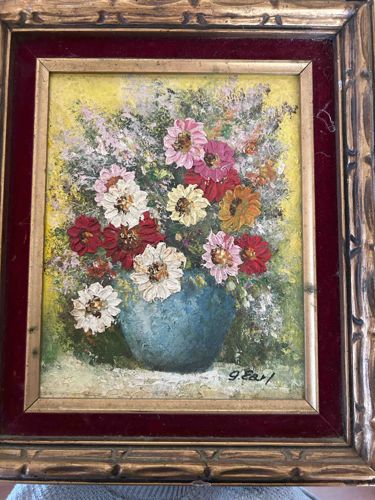
Impasto Floral Still Life in Blue Vase Signed G. Earl

Fine Art - Paintings

AI Estimated Value

·Not an official valuation·Verify before acting

$250-$450

As of June 17, 2026

AI Item Analysis

·AI can make mistakes·Verify before acting
This is a mid-to-late 20th-century floral still life oil painting executed with a heavy impasto technique. The composition features a lush bouquet of zinnias or dahlias in shades of pink, white, deep red, and orange, arranged within a rounded blue ceramic vase. The background is rendered in thick dabs of yellow, white, and green, suggesting a bright and airy environment. A notable feature is the textured application of paint, where the artist has used a palette knife or thick brush to create three-dimensional relief on the flower petals and foliage. The work is signed 'G. Earl' in the lower right-hand corner in black paint. The painting is housed in a decorative ornate gilt wood frame, which includes a deep burgundy or maroon velvet-covered liner that provides a textural contrast to the gold moulding. The frame shows characteristic signs of age, including light dust accumulation within the velvet fibers and minor surface abrasions on the gilt edges. The overall construction suggests a commercial art gallery piece likely dating from the 1960s to 1980s. The impasto is well-preserved with no immediate signs of cracking or flaking, indicating a stable paint film. The style and signature are consistent with decorative mid-century European or American studio works intended for interior design.

AI Appraisal Report

·AI can make mistakes·Verify before acting
Upon examination of the 'G. Earl' floral still life, I find it to be a quintessential example of mid-to-late 20th-century decorative studio art. The impasto technique is executed with confidence, utilizing a palette knife to create a tactile, three-dimensional surface that remains in excellent stability with no visible craquelure or pigment loss. The ornate gilt frame with the velvet liner is typical of the 1960s-1980s aesthetic, further dating the piece to this period of commercial gallery production. While the signature 'G. Earl' is clearly legible, this artist is categorized as a commercial or 'decorator' painter whose works were produced for the interior design market rather than the high-end secondary auction market. Market demand for these mid-century still lifes remains steady among vintage enthusiasts, though they do not command the premium prices of listed fine artists. The value is largely driven by the work's decorative appeal and the high quality of the framing. Limitations: This appraisal is based on digital images and cannot verify the substrate condition or detect overpainting without UV inspection. A physical examination would be required to confirm the oil medium's age and ensure the frame's integrity. No provenance was provided; however, for works of this nature, documentation of origin is less critical than for investment-grade fine art. Professional scientific testing is not recommended as the cost would exceed the fair market value of the painting.

Get your items appraised

Instant estimates of your treasures with AI-powered appraisals

Browse More Appraisals