These notes were written by the person who submitted this item. Appraiser.AI has not verified them, and the AI's identification and estimate may rely on them.
AI Estimated Value
Not an official valuation
$25 - $45
AI estimate as of December 4, 2025 · verify with a professional before acting
AI-Generated · Verify before acting
Everything on this page is generated by AI for informational purposes only. AI can make mistakes — the AI may misidentify items or misattribute them (artist, maker, brand, designer, origin, era). This is not an official valuation and should not be used for insurance, sale, tax, estate, legal, or lending purposes — or any decision requiring a certified appraisal. It is not an authoritative claim about any person, brand, or rights holder — do not share or rely on it as a factual statement about a third party. Always consult qualified professionals before making financial decisions.
This analysis also relies on unverified notes provided by the user, which may be incomplete or inaccurate and could affect the result.
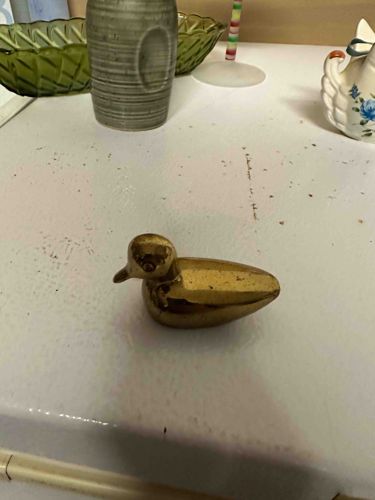
This item is a small, solid brass figurine depicting a duck or drake. The duck is rendered in a somewhat stylized, minimalist form, facing to the left in the image. It features a polished golden-yellow brass finish, showing some minor surface wear, tarnish, and possible oxidation, consistent with age and handling. The bird's head is distinct, with a small, rounded beak and what appear to be inset or etched eyes that are difficult to discern clearly from the provided image but suggest a darker color. The body is smoothly contoured, with a slightly flattened top and sides that taper towards the rear, giving it a sleek appearance. There are no obvious detailed feather markings or highly realistic anatomical features, suggesting a decorative rather than anatomical representation. The underside is not visible, so manufacturer's marks or signatures cannot be observed. Given the style and material, it likely dates from the mid-20th century, possibly as a desk ornament, paperweight, or decorative accent. The craftsmanship appears to be of decent quality for an ornamental piece, with smooth casting and a generally well-finished surface, although minor imperfections like small dark spots or scratches are present.
AI Appraisal Report
I have virtually examined this vintage brass duck figurine. The piece appears to be a solid brass casting, featuring a stylized, minimalist design characteristic of mid-20th century decorative items. Its polished golden-yellow finish, combined with visible minor surface wear, tarnish, and oxidation, suggests authenticity in terms of age and material. The craftsmanship seems decent for an ornamental item, with smooth contours, though minor imperfections like small dark spots or scratches are present, which are consistent with age and use. The duck’s head, rounded beak, and what appear to be inset eyes contribute to its decorative appeal.
Authenticity verification is limited by the visual nature of this appraisal. While the general appearance aligns with vintage brass figurines, an in-person examination would be crucial to confirm the exact metal composition, weight, and detect any potential repairs or alterations not visible in the images. Verification of the 'Century' attribution would require direct inspection for manufacturer's marks or signatures, which are currently obscured as the underside is not visible.
Market conditions for such brass decorative items are moderately stable. These pieces are popular among collectors of vintage desk accessories or home décor. However, demand is not exceptionally high, and they are not considered rare. Comparable items typically fetch modest prices. Factors impacting value include the material (solid brass), age, overall condition, and decorative appeal. The lack of detailed provenance or a clearly identifiable maker's mark limits its collectible value to some extent.
Given these considerations, I estimate the appraisal value for this Vintage Brass Duck Figurine to be in the range of $25 to $45. This reflects its condition, design, material, and current market demand for similar vintage decorative brass items. A physical inspection would allow for a more definitive assessment of its condition, potential markings, and thus, a more precise valuation.