AI estimate as of August 1, 2025 · verify with a professional before acting
AI-Generated · Verify before acting
Everything on this page is generated by AI for informational purposes only. AI can make mistakes — the AI may misidentify items or misattribute them (artist, maker, brand, designer, origin, era). This is not an official valuation and should not be used for insurance, sale, tax, estate, legal, or lending purposes — or any decision requiring a certified appraisal. It is not an authoritative claim about any person, brand, or rights holder — do not share or rely on it as a factual statement about a third party. Always consult qualified professionals before making financial decisions.
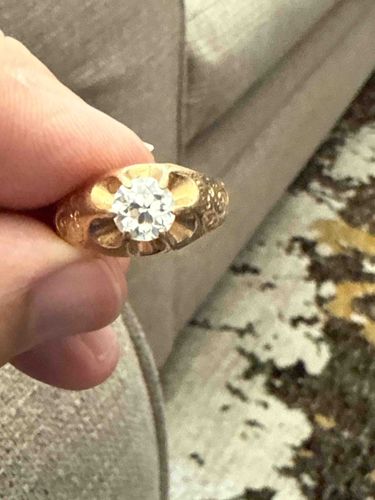
The item is a roughly finger-sized gold ring, specifically a solitaire-style ring, featuring a single, prominent diamond set in its center. The gold metal appears to be yellow gold, possibly 14k or 18k, given its rich hue, and shows a noticeable patina consistent with age and wear, though this contributes to its vintage appeal. The ring's band is relatively thick and substantial, widening towards the setting. The setting for the diamond is a prominent feature, appearing to be an illusion setting or a bezel-like setting that cradles the stone, making it appear larger and more integrated into the ring's design. The diamond itself is a brilliant-cut stone, exhibiting good fire and sparkle, although precise clarity and color grading are not possible from the image. It appears to be a natural diamond due to the play of light. The ring displays intricate, embossed or engraved decorative patterns on its shoulders, extending some distance down the band. These patterns are abstract, possibly floral or scrolled motifs, adding a touch of ornate detailing to the piece. The craftsmanship suggests a hand-finished or semi-hand-finished item, indicated by the depth and texture of the engraved areas. There are no visible maker's marks or signatures in the image. Given the style of the setting and the decorative work, the ring likely dates to the early to mid-20th century, possibly an Art Deco or Retro era piece. General wear is evident, such as minor scratches and dulling of the metal in some areas, but no significant damage or repairs are immediately apparent. The overall condition appears to be good for its presumed age, showcasing its historical integrity and quality.
AI Appraisal Report
Upon visual examination of the provided image, this Vintage Gold Solitaire Diamond Ring presents as a charming, likely hand-finished piece consistent with early to mid-20th century craftsmanship, possibly from the Art Deco or Retro era. The gold appears to be yellow gold, and its rich hue suggests 14k or 18k purity. The intricate, embossed/engraved patterns on the shoulders add significant character and detail. The central diamond, a brilliant-cut stone, exhibits good fire and sparkle, appearing natural. The illusion/bezel-like setting effectively enhances the stone’s apparent size. For its presumed age, the ring is in good overall condition, showing expected minor wear like scratches and dulling, but no apparent major damage or repairs. This contributes positively to its market desirability as a genuine vintage item.
Market conditions for vintage jewelry, particularly classic solitaire designs with detailing, remain stable with consistent demand, especially for pieces that retain their original character and patina. Comparable pieces often fetch fair prices, depending heavily on the precise carat weight, color, and clarity of the diamond, as well as the gold purity and uniqueness of the setting/detailing. The ornate shoulders enhance its uniqueness and appeal, potentially increasing its market value over plainer solitaire rings. Rarity is moderate; while vintage solitaires are not exceedingly rare, this specific combination of a significant diamond within an ornately detailed, period-specific setting suggests a less common find.
Factors significantly impacting value include the diamond's exact specifications (carat, cut, color, clarity), which cannot be definitively determined from an image. Without laboratory grading, this remains a primary limitation. The gold weight and purity are also estimations. Authentication limitations are notable; I cannot, from an image alone, confirm the authenticity of the diamond as natural versus lab-grown, nor can I verify the gold purity. To fully authenticate the item and provide a precise valuation, an in-person examination would be critical to assess the diamond’s properties with gemological tools, test the gold, and search for any obscured maker's marks. Provenance documentation, if available, would further substantiate its historical context and value.