AI estimate as of July 4, 2025 · verify with a professional before acting
AI-Generated · Verify before acting
Everything on this page is generated by AI for informational purposes only. AI can make mistakes — the AI may misidentify items or misattribute them (artist, maker, brand, designer, origin, era). This is not an official valuation and should not be used for insurance, sale, tax, estate, legal, or lending purposes — or any decision requiring a certified appraisal. It is not an authoritative claim about any person, brand, or rights holder — do not share or rely on it as a factual statement about a third party. Always consult qualified professionals before making financial decisions.
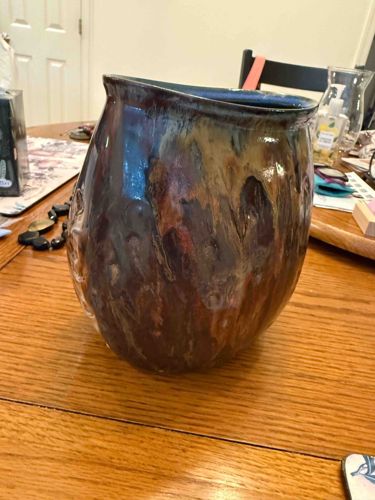
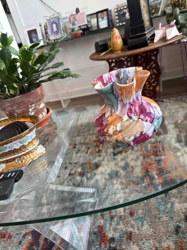
This item is a handcrafted ceramic vase or pot, exhibiting an organic, somewhat irregular form. Its physical characteristics align with a studio pottery aesthetic, suggesting it was produced by an artisan rather than mass-manufactured. The vessel has a bulbous body that tapers slightly towards an opening, which appears to have an uneven or wavy rim, adding to its artisanal charm. The primary material is clay, finished with a complex and iridescent glaze. The dominant colors include deep browns and earthy tones, interspersed with striking blues, coppers, and perhaps hints of purple. These colors are not uniformly applied but rather appear to run and meld into each other, creating a 'lava lamp' or multi-layered effect, indicative of a reactive or crystalline glaze firing process. Distinctive features include the rich, variegated surface texture resulting from the glaze, which seems to shimmer and change appearance depending on the light. There are no immediately visible cracks, chips, or significant damage, suggesting it is in good, used condition. The presence of these unique glaze patterns suggests high heat firing techniques were employed. No specific maker's marks or signatures are visible from the provided image, so its exact origin or age is difficult to pinpoint, but the style is consistent with contemporary or late 20th-century to early 21st-century studio pottery. Its construction appears robust, and the quality of craftsmanship is apparent in the evenness of the form and the intricate glaze application, indicating a skilled hand. The unique interplay of colors and textures makes it a distinctive decorative piece.
AI Appraisal Report
Upon visual examination of the provided image, I assess this studio pottery vase/pot to be in good, used condition. No significant cracks, chips, or repairs are immediately apparent, which is crucial for maximizing collectible value. The authenticity as a handcrafted studio piece is highly probable given its irregular form, unique glaze, and tactile appearance, indicative of artisanal production rather than mass manufacturing. However, full authentication without physical inspection is limited. I would need to handle the piece to inspect the base for maker's marks, feel the texture, and examine the interior for signs of original craftsmanship versus later alterations or damage. Provenance documentation, such as artist's receipts or exhibition records, would also significantly aid in authenticating its origin and age.
Market conditions for studio pottery, particularly pieces with unique glazes and organic forms, remain robust. Items displaying reactive or crystalline glazes, like this one, are often sought after for their aesthetic appeal and perceived uniqueness. While I cannot identify a specific artist without a signature, the unique 'lava lamp' or multi-layered iridescent glaze is a strong selling point. Comparables would include contemporary and late 20th/early 21st-century art pottery from unnamed or lesser-known artisans specializing in distinctive glazes. Demand for unique, high-quality decorative arts pieces remains steady, and the absence of clear attribution means it falls into a broader collectible ceramics market rather than a specific artist-driven one.
Rarity is moderate; while unique in its specific glaze pattern, similar studio pottery forms and glaze techniques do exist. Factors positively impacting value include the excellent apparent condition, the stunning and complex glaze, and its unique, handcrafted aesthetic. Factors limiting value include the lack of an identifiable artist or provenance, which prevents it from entering a higher-value artist-specific market. If an artist's mark were present and attributable to a known potter, the value would significantly increase.