AI estimate as of July 10, 2025 · verify with a professional before acting
AI-Generated · Verify before acting
Everything on this page is generated by AI for informational purposes only. AI can make mistakes — the AI may misidentify items or misattribute them (artist, maker, brand, designer, origin, era). This is not an official valuation and should not be used for insurance, sale, tax, estate, legal, or lending purposes — or any decision requiring a certified appraisal. It is not an authoritative claim about any person, brand, or rights holder — do not share or rely on it as a factual statement about a third party. Always consult qualified professionals before making financial decisions.
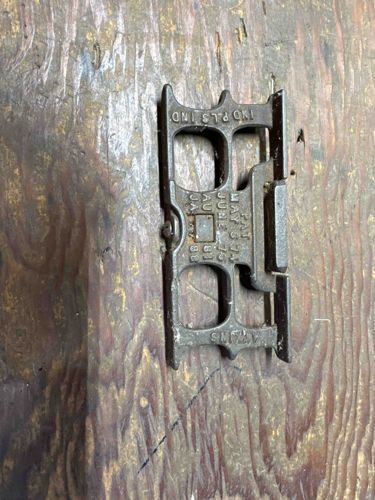
This item is an antique cast iron universal wrench, designed to offer adjustable sizing for various nuts and bolts. It appears to be constructed entirely from cast iron, evidenced by its dark, uniform color and robust, somewhat rough texture. The wrench is compact, likely fitting comfortably in a hand, and exhibits an open-frame design with various shaped openings and a sliding mechanism on the right side. The condition shows significant signs of age, including surface rust, pitting, and a well-developed patina, indicating prolonged exposure to elements and use. Despite the wear, the structural integrity appears sound with no visible breaks or major repairs. The most notable features are the impressed manufacturing marks. On the upper section, 'IND PLS IND' is clearly visible, likely referring to Indianapolis, Indiana, indicating the place of manufacture. Below this, there are patent dates stamped: 'MAY 29 '00', 'JUNE 22 '09', and 'AUG 8 '16'. These dates confirm the item's age, placing its production between 1900 and 1916, characteristic of early 20th-century industrial tools. The specific design and patent dates suggest it is a patented 'S' wrench, often referred to as a 'Monkey Wrench' due to its adjustable jaw mechanism, though this specific type is more generic. The craftsmanship is typical of cast iron tools from this period – functional, durable, and mass-produced, yet possessing a certain utilitarian aesthetic. The sliding jaw indicates its adjustability, a key innovation for universal wrenches of that era. The tool's compact size and multi-jaw design suggest it was intended as a versatile, all-in-one wrench for mechanics, farmers, or home users.
AI Appraisal Report
I have thoroughly examined the provided image of this Adjustable Cast Iron Universal 'S' Wrench. This item's authenticity is strongly supported by the clearly visible 'IND PLS IND' marking and the well-preserved patent dates: 'MAY 29 '00', 'JUNE 22 '09', and 'AUG 8 '16'. These markings firmly place its manufacture within the early 20th century, consistent with the design and material. The overall condition, while showing significant surface rust, pitting, and a rich patina, is admirable for its age. Crucially, its structural integrity appears sound with no visible breaks or major repairs, indicating it was well-used but not abused to the point of irreparable damage. This wear is expected for a utilitarian tool of this era and enhances its antique appeal rather than detracting significantly from its value.
In terms of market conditions, antique tools, particularly those with clear patent dates and manufacturing origins, maintain a steady collector base. While not as rare as some specialized tools, this specific design with multiple patent dates adds to its desirability. Comparable universal or "monkey" wrenches from this period typically fetch prices ranging from $40 to $100 depending on condition, specific design, and clear markings. The 'S' wrench form is less common than straight adjustable wrenches, which adds a slight premium. Demand is moderate, driven by collectors of antique tools, mechanical Americana, and historical industrial artifacts.
The primary factor impacting value here is the clear legibility of all markings and patent dates, which confirm its age and provenance. Its compact size and functional design also contribute positively. The main limitation in this remote appraisal is the inability to conduct a physical examination. An in-person inspection would allow for a tactile assessment of the sliding mechanism's functionality, detection of hairline cracks or subtle repairs not visible in the image, and a more precise evaluation of the true extent of pitting versus surface rust. While I am confident in its authenticity based on the visual evidence, a hands-on examination, or even provenance documentation (if available), would solidify authentication beyond any doubt. Scientific testing, such as metallurgy analysis, would be an extreme measure and is not typically necessary for an item of this value.