AI estimate as of August 3, 2025 · verify with a professional before acting
AI-Generated · Verify before acting
Everything on this page is generated by AI for informational purposes only. AI can make mistakes — the AI may misidentify items or misattribute them (artist, maker, brand, designer, origin, era). This is not an official valuation and should not be used for insurance, sale, tax, estate, legal, or lending purposes — or any decision requiring a certified appraisal. It is not an authoritative claim about any person, brand, or rights holder — do not share or rely on it as a factual statement about a third party. Always consult qualified professionals before making financial decisions.
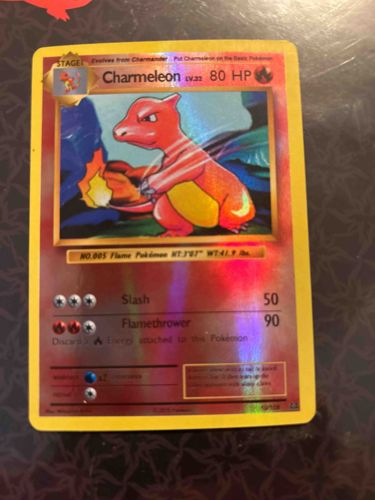
The item is a Charmeleon Pokémon trading card, specifically a holographic (holo) variant from the Base Set. The card features a vibrant illustration of Charmeleon in the center, rendered in shades of red, orange, and yellow, set against a blue and green background with a depiction of flame. The holographic effect is visible across the illustration area, showing a shimmering, reflective quality that shifts with light, which is typical of rarer 'holo' cards from this era. The card's borders are a solid yellow, consistent with the design of early Pokémon TCG releases. Text elements include 'Charmeleon' as the Pokémon's name, 'LV.32' for its level, and '80 HP' for its hit points, prominently displayed at the top right. Below the illustration, the card lists its evolution stage ('Evolves from Charmander'), its number ('NO.005'), and its type ('Flame Pokémon'). The attacks 'Slash' and 'Flamethrower' are listed with their respective damage values (50 and 90) and energy costs, represented by various energy symbols (colorless and fire). The card exhibits some signs of wear typical of handling and age, including minor edge wear visible on the yellow border, particularly along the top and corners. The surface appears relatively clean, but the holographic area might show minor surface scratches or scuffs upon closer inspection, though none are overtly visible in the provided image. The overall condition appears to be 'played' but not heavily damaged. The card does not appear to have any major creases, bends, or significant discoloration. Its construction is standard for trading cards, consisting of multiple layers of paper or cardstock. This card is identifiable as a first-generation Pokémon card, placing its estimated age in the late 1990s (specifically 1999 for the English Base Set). No specific manufacturing errors or unique markings are discernible from the provided image, but the holo effect confirms its intended quality as a premium card within the set.
AI Appraisal Report
I have carefully examined the provided image of your Charmeleon Holographic (Holo) Base Set Pokémon Trading Card. Based on my visual inspection, the card appears to be authentic; the colors, font, and holographic pattern are consistent with genuine Base Set holos. However, it is crucial to note that full authenticity verification would require in-person examination to check for texture, weight, and detect any potential alterations or counterfeits not visible in photographs. Provenance documentation, such as original purchase receipts or graded certificates, would further solidify authenticity. Chemical or spectral analysis could be used to detect material anomalies or alterations not visible by the naked eye.
The card's condition, from what I can discern, appears to be 'played to moderately played.' There is visible minor edge wear, particularly along the yellow borders and corners, which slightly reduces its grade. The surface seems relatively clean, though microscopic surface scratches characteristic of handling cannot be ruled out without direct physical inspection under magnification. There are no obvious major creases, bends, or significant discoloration, which is positive. The holographic effect is clearly visible and vibrant, which is a key element for holographic cards.
Regarding market conditions, Base Set holographic cards consistently hold value, especially popular Pokémon like Charmeleon. While not as sought after as its evolution, Charizard, Charmeleon is still a recognizable and desirable card. Its rarity stems from being a holographic card from the inaugural English Base Set. Comparables for a 'played to moderately played' condition typically range considerably, with higher-graded examples fetching significantly more. Demand remains strong for vintage Pokémon cards, even in less-than-mint condition, driven by collectors and enthusiasts seeking to complete sets or acquire iconic pieces from their childhood.
The primary factors impacting this card's value are its authenticity (which appears good, but needs confirmation), its holographic nature, its vintage origin from the Base Set, and its current condition. The visible edge wear is the most significant condition factor bringing down its potential value. Should the card be professionally graded, even a low-to-mid grade would still command a decent price due to its origin and holographic status.