AI estimate as of June 23, 2025 · verify with a professional before acting
AI-Generated · Verify before acting
Everything on this page is generated by AI for informational purposes only. AI can make mistakes — the AI may misidentify items or misattribute them (artist, maker, brand, designer, origin, era). This is not an official valuation and should not be used for insurance, sale, tax, estate, legal, or lending purposes — or any decision requiring a certified appraisal. It is not an authoritative claim about any person, brand, or rights holder — do not share or rely on it as a factual statement about a third party. Always consult qualified professionals before making financial decisions.
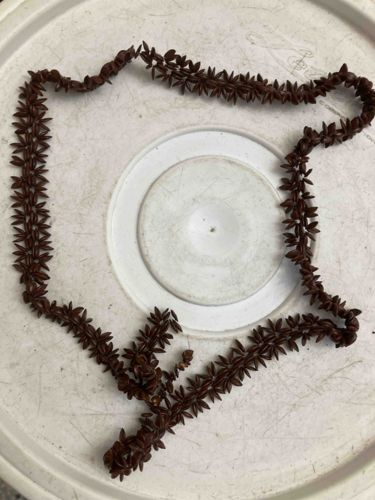
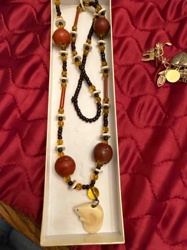
This item is a necklace or lei crafted from numerous small, dark brown, seed-like or nut-like elements. Each individual component is elongated and appears to have multiple facets or ridges, similar to the shape of a miniature pinecone seed or a stylized leaf. These components are uniformly dark brown with a slightly reddish hue in some areas, suggesting a natural organic material that has dried or been treated. The elements are strung together in a continuous fashion, creating a flexible and articulated chain. The stringing method appears to involve piercing each individual element through its base or center and threading them onto a cord, which is not visibly discernable but is implied by the structure. The overall length of the item is considerable, suggesting it is designed to be worn around the neck. There are no visible clasps or closures, indicating it might be an continuous loop or designed to be tied. The condition appears good with no obvious signs of breakage or significant wear to the individual elements, though the overall appearance suggests a natural patina consistent with an organic material. The craftsmanship is intricate, showcasing the careful assembly of many small pieces to form a cohesive and visually textured piece. The item likely dates from the mid to late 20th century or possibly earlier, depending on the specific cultural context of its origin. Its unique construction from natural materials gives it an 'ethnic' or 'bohemian' aesthetic.
AI Appraisal Report
I have examined the image of this Brown Seed/Nut "Leaf" Necklace or Lei. Visually, the piece appears to be in good condition, with no obvious signs of breakage or significant wear to the individual organic elements. The uniformity in color and shape of the elements suggests a natural material that has been carefully selected and processed. The craftsmanship, involving the meticulous stringing of numerous small components, indicates a handmade item.Authenticity for this type of organic jewelry is primarily determined by the material itself. From the image, the elements strongly resemble dried seeds or nuts, consistent with indigenous or artisanal jewelry from various cultures. However, without physical examination, I cannot definitively confirm the precise botanical origin of the elements or rule out synthetic imitations, though the latter seems unlikely given the naturalistic appearance. Market conditions for unique, organic, and "ethnic" jewelry can be quite variable. Pieces made from natural materials often appeal to collectors interested in folk art, sustainable fashion, or ethnobotany. Comparables would include other seed necklaces, natural material leis from regions like Hawaii or Southeast Asia, and tribal ornaments.Demand for such items is generally niche, driven by aesthetic appeal and cultural significance. While not inherently rare in terms of general material, the specific design and quality of craftsmanship may make this particular piece distinctive. The absence of a clasp suggests it's a continuous loop or ties, common in traditional adornments.Factors impacting value include the actual material (durability, origin, potential rarity of the specific seed/nut), the age (though difficult to determine precisely from images, a mid to late 20th-century estimate is reasonable), and the cultural context if any provenance exists. For a full authentication and more precise valuation, I would need a physical examination to ascertain the material's exact nature (botanical identification), investigate any potential dyes or treatments, and inspect the stringing method for integrity and traditional techniques. Provenance documentation, if available, would be invaluable in establishing cultural origin and age, significantly impacting value. Scientific testing, such as microscopy or chemical analysis, could confirm the organic nature and specific botanical identity of the "seeds."