AI estimate as of October 26, 2025 · verify with a professional before acting
AI-Generated · Verify before acting
Everything on this page is generated by AI for informational purposes only. AI can make mistakes — the AI may misidentify items or misattribute them (artist, maker, brand, designer, origin, era). This is not an official valuation and should not be used for insurance, sale, tax, estate, legal, or lending purposes — or any decision requiring a certified appraisal. It is not an authoritative claim about any person, brand, or rights holder — do not share or rely on it as a factual statement about a third party. Always consult qualified professionals before making financial decisions.
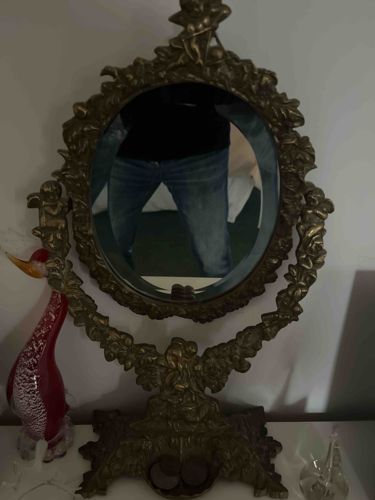
This item is a decorative table-top vanity mirror, likely crafted in a Victorian or Art Nouveau-inspired style. The primary material appears to be brass or a brass-toned metal, exhibiting a dark, aged patina which suggests either considerable age or an intentional antiquing finish. The central feature is an oval-shaped mirror glass, currently reflecting the lower body of a person. The frame surrounding the mirror is heavily ornamented with intricate foliate (leaf and vine) motifs and includes multiple figures of small cherubs or putti. Two cherubs are prominently featured at the very top of the frame, seemingly supporting a small crown or finial element. Additional cherub figures are integrated into the ornate scrolling on the sides of the frame. The mirror is adjustable, mounted on two scrolling arms that connect to a substantial, decorative base. The base itself is also highly detailed with complementary foliate designs and features two prominent, circular depressions or holders, possibly for small trinkets or candlesticks. The overall craftsmanship suggests a cast metal construction, with fine details discernible within the decorative elements. The condition appears to be good with a consistent, dark patina. There are no immediately visible signs of damage, cracks, or repairs to the metalwork or the mirror itself. The style suggests an estimated age from the late 19th to early 20th century, or a more modern reproduction inspired by these periods. The rich ornamentation and figurative elements are characteristic of the elaborate decorative arts popular during those eras. The quality of the casting and the intricate details indicate a well-made, substantial piece.
AI Appraisal Report
Upon visual examination of the provided image, I assess this Victorian Style Cherub & Foliate Brass Vanity Mirror to be in very good condition. The dark, aged patina appears consistent and intentionally antiqued, or naturally occurring over time, enhancing its aesthetic appeal. I observe no obvious damage, such as cracks, dents, or significant losses to the intricate brass metalwork, nor any visible imperfections to the oval mirror glass. The elaborate foliate motifs and cherub figures are well-defined, suggesting quality casting. The adjustable mechanism seems intact.
Authenticity is a key consideration. While the elaborate ornamentation, cherubim, and overall design are undeniably characteristic of late 19th to early 20th-century Victorian or Art Nouveau styles, I must couch my certainty regarding its age from an image alone. It displays the hallmarks of a period piece, but without in-hand inspection, it is difficult to definitively rule out a high-quality reproduction. The richness of detail and substantial look, however, lean towards an authentic antique rather than a modern, mass-produced item.
Market conditions for such decorative vanity mirrors are generally stable, with a consistent demand from collectors of Victorian decorative arts, Art Nouveau enthusiasts, and those seeking accent pieces for period-style interiors. These pieces are not exceptionally rare, but well-preserved examples with intricate detailing like this one command higher interest. Comparables for similar ornate brass or bronze vanity mirrors from the late 19th/early 20th century typically fetch between $500 and $1,200, depending on provenance, exact artist/manufacturer attribution, and specific condition. This piece falls into the higher end of that range due to its complex design and apparent good condition.
Factors significantly impacting value include the clear, detailed casting, the intact original mirror (if verified), and the absence of repairs. The two circular depressions in the base, potentially for small trinkets or candlesticks, add to its functional appeal and design complexity. Its substantial size and impressive ornamentation contribute positively to its market desirability.
Limitations in authenticity verification from images alone are crucial to note. While the visual indicators are strong, an in-person examination would be required to verify the composition of the metal (e.g., solid brass vs. plated), to detect any repairs or restorations not visible in the photograph, and to inspect for any maker's marks or foundry stamps that would definitively establish provenance and age. XRF testing could confirm the metal composition, and a closer inspection of surface wear patterns could further distinguish between genuine age and applied antiquing. Provenance documentation, if available, would significantly enhance certainty regarding its age and origin.