These notes were written by the person who submitted this item. Appraiser.AI has not verified them, and the AI's identification and estimate may rely on them.
AI Estimated Value
Not an official valuation
$150-300
AI estimate as of November 28, 2025 · verify with a professional before acting
AI-Generated · Verify before acting
Everything on this page is generated by AI for informational purposes only. AI can make mistakes — the AI may misidentify items or misattribute them (artist, maker, brand, designer, origin, era). This is not an official valuation and should not be used for insurance, sale, tax, estate, legal, or lending purposes — or any decision requiring a certified appraisal. It is not an authoritative claim about any person, brand, or rights holder — do not share or rely on it as a factual statement about a third party. Always consult qualified professionals before making financial decisions.
This analysis also relies on unverified notes provided by the user, which may be incomplete or inaccurate and could affect the result.
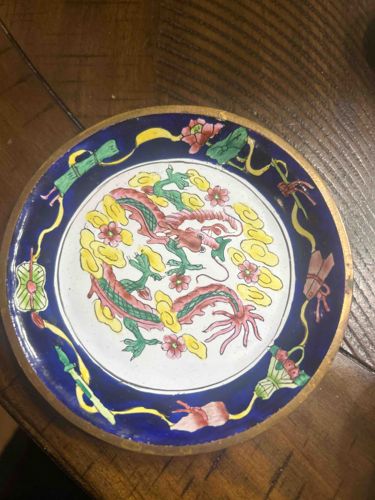
This item is a circular enamel plate, likely made of brass or copper with cloisonné enamel decoration, originating from China. The plate features a central medallion with a vibrant design of a stylized five-clawed dragon, typically associated with imperial symbolism. The dragon is depicted with a predominantly reddish-pink body, green scales, and yellow detailing for its mane and cloud-like forms. Small pink floral motifs are interspersed within the central design. Surrounding the central medallion is a dark blue band, creating a distinct border. This blue band is adorned with a decorative motif featuring yellow ribbon-like scrolls from which various auspicious objects or symbols are suspended. These include green bundles, pink and red florals, and what appear to be hanging lanterns or tassels in various colors like green, pink, and red. The outer rim of the plate is a raised brass or gilt-colored edge, which shows some wear and tarnishing consistent with age and handling. The enamel work exhibits a bright, multi-colored palette, characteristic of Chinese cloisonné. There are visible signs of wear, including minor chips or abrasions in the enamel, particularly noticeable on the blue border, and some discoloration or patina on the metallic rim. The construction appears sturdy, suggesting a traditional enameling process where colored glass paste is applied within wire outlines and then fired. The overall aesthetic points to a late 19th to mid-20th century East Asian decorative art style, commonly produced as ornamental pieces. The quality of the enamel application appears consistent, with clear outlines defining the intricate patterns, demonstrating a good level of craftsmanship.
AI Appraisal Report
Based on my visual examination of the provided image, this Chinese Enamel Cloisonné Dragon Plate presents as a decorative art piece from the late 19th to mid-20th century. The construction, with brass or copper substrate and intricate cloisonné enamel work, is consistent with typical Chinese production of this period. The five-clawed dragon motif is historically significant, often associated with imperial power, though its use on a decorative plate like this doesn't automatically confer imperial provenance. The vibrant colors and clear outlines suggest a good level of craftsmanship for its type. The condition is fair; I observe visible wear, including minor chips or abrasions in the enamel, particularly on the blue border, and expected tarnishing on the metallic rim. These condition issues are typical for an item of this age that has been handled and displayed, and they slightly diminish its overall collectible value.
In terms of market conditions, similar Chinese cloisonné decorative plates from this era are relatively common. While the dragon motif is popular, the demand tends to be for pieces in excellent condition or those with exceptional artistry or known historical significance, which this item, based on imagery alone, does not strongly convey. Comparables on the secondary market often range from $100-$400 for plates of similar size, age, and condition. Rarity is not a significant factor here; these items were produced in considerable quantities for export and domestic markets. The "made in China" detail, while expected, doesn't add specific value without further context.
My appraisal value of $150-300 reflects the decorative appeal, age, and fair condition, balanced against the commonality of such items in the current market. Without direct physical examination, I cannot definitively confirm the base metal (brass vs. copper) or the precise quality of the enamel application and firing, which can affect value. A hands-on inspection would allow me to assess the weight, tactile quality of the enamel, and better gauge the extent and nature of any damage. Furthermore, documentation of provenance would be crucial to verify any specific historical context or imperial association mentioned. Scientific testing could verify material composition and age with greater precision, which would be essential for authenticating a truly high-value piece or confirming imperial origin.