AI estimate as of October 26, 2025 · verify with a professional before acting
AI-Generated · Verify before acting
Everything on this page is generated by AI for informational purposes only. AI can make mistakes — the AI may misidentify items or misattribute them (artist, maker, brand, designer, origin, era). This is not an official valuation and should not be used for insurance, sale, tax, estate, legal, or lending purposes — or any decision requiring a certified appraisal. It is not an authoritative claim about any person, brand, or rights holder — do not share or rely on it as a factual statement about a third party. Always consult qualified professionals before making financial decisions.
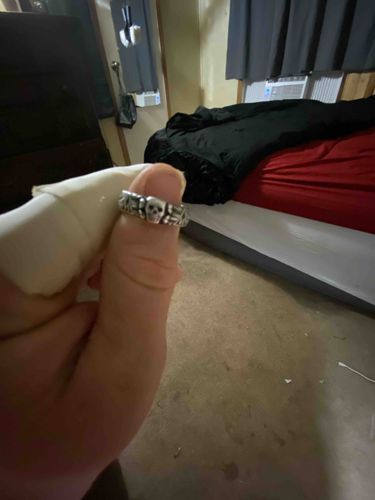
The item is a unisex band-style ring featuring a repeated motif of skulls and possibly crossbones, though the latter detail is less clear in the provided image. The ring appears to be made of a silver-toned metal, likely sterling silver, stainless steel, or a silver-plated base metal, given its metallic luster and color. Its finish suggests an antiqued or oxidized treatment in the recessed areas, which enhances the three-dimensional quality of the skull design and provides contrast against the brighter raised surfaces. The central feature is a prominent skull, flanked by what appear to be smaller skulls or perhaps crossbone elements, creating a continuous pattern around the band. The craftsmanship appears to be robust, with clearly defined features on the skulls, including eye sockets, nasal cavities, and teeth, indicating decent detailing for a mass-produced or artisan piece. There are no visible maker's marks or stamps in the image, preventing identification of the manufacturer or specific material composition without further inspection. The ring’s condition appears good, with no obvious signs of significant wear, damage, or repairs, consistent with a relatively new or well-maintained piece of jewelry. This style of ring is often associated with gothic, biker, or rock fashion subcultures, suggesting an estimated age from the late 20th century to contemporary. Its design indicates a decorative and expressive purpose rather than a ceremonial or historically significant one. The quality of casting seems decent, with smooth edges and no apparent burrs from the close-up view.
AI Appraisal Report
I have examined the provided image of the Skull and Crossbones Band Ring. Visually, the ring appears to be in good condition with no obvious signs of significant wear, damage, or repairs. The detailing on the skulls, including eye sockets and teeth, is clearly defined, suggesting decent craftsmanship. The silver-toned metal, likely sterling silver, stainless steel, or a silver-plated base, shows an antiqued finish in recessed areas, enhancing the design's dimensionality. Based on the visual evidence, it appears authentic to its style, fitting a gothic, biker, or rock aesthetic. This is a decorative piece, not ceremonial or historically significant.
Market conditions for such rings are competitive, with many similar designs available from various manufacturers. Comparables include mass-produced stainless steel rings in the $15-$40 range and sterling silver versions from artisan makers or larger brands in the $50-$150 range. Demand for this style is niche but consistent within its subcultures. Rarity is low; many similar items are produced. Factors impacting value include the actual metal composition, which is unknown from the image, and the presence of any maker's marks.
Limitations in authenticity verification are significant. Without physical inspection, I cannot confirm the specific metal composition (e.g., sterling silver vs. stainless steel vs. plated base metal), which is the primary driver of value for this type of item. I also cannot verify the presence or absence of manufacturer's stamps or hallmarks. A physical examination, ideally with a jeweler's loupe, specific gravity testing for metal identification, or material analysis (e.g., XRF scanning), would be needed for full authentication and an accurate material assessment. Provenance documentation (receipts, certifications) would also confirm its origin and material claims. Assuming it is a mid-range quality item, likely sterling silver or good quality stainless steel, my appraisal reflects this."