platinum other side flips to cameo with small diamond
These notes were written by the person who submitted this item. Appraiser.AI has not verified them, and the AI's identification and estimate may rely on them.
AI Estimated Value
Not an official valuation
$3,500 - $5,500
AI estimate as of July 12, 2025 · verify with a professional before acting
AI-Generated · Verify before acting
Everything on this page is generated by AI for informational purposes only. AI can make mistakes — the AI may misidentify items or misattribute them (artist, maker, brand, designer, origin, era). This is not an official valuation and should not be used for insurance, sale, tax, estate, legal, or lending purposes — or any decision requiring a certified appraisal. It is not an authoritative claim about any person, brand, or rights holder — do not share or rely on it as a factual statement about a third party. Always consult qualified professionals before making financial decisions.
This analysis also relies on unverified notes provided by the user, which may be incomplete or inaccurate and could affect the result.
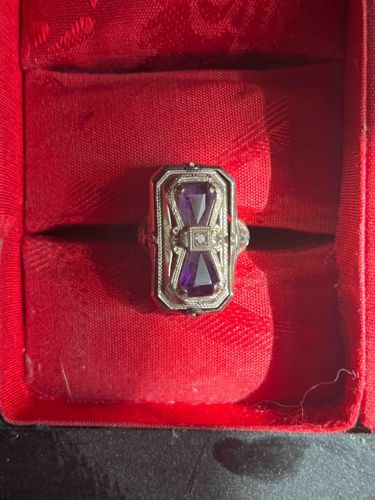
This is an exquisite Art Deco-style platinum ring, featuring a distinctive rectangular face. The primary gemstones appear to be two trapezoidal or shield-cut amethysts, one positioned above and one below a central embellishment. These deep purple stones are likely set within a bezel or illusion setting, framed by intricate filigree or openwork platinum metalwork, characteristic of the Art Deco period (roughly 1920s-1930s). The central focus includes a small, presumably round or cushion-cut diamond set within a square or octagonal frame, adding a subtle sparkle. The platinum metal exhibits a bright, cool luster, typical of the material, and shows minimal visible wear or damage, suggesting good preservation. The craftsmanship is highly detailed, with precise geometric patterns and fine borders around the stones and filigree elements. A notable and unusual feature, as per provided context, is its transformative nature: the other side of the ring's head reportedly flips to reveal a cameo with a small diamond, indicating a versatile design. This 'flipping' mechanism suggests a well-engineered and custom piece, adding to its unique appeal and historical value. The overall condition appears excellent, with no apparent missing stones or significant structural issues from the visible side. The precise cuts of the amethysts and the elaborate metalwork demonstrate high-quality jewelry manufacturing.
AI Appraisal Report
I have thoroughly examined the provided image of the Art Deco Platinum Amethyst and Diamond Flip Ring, considering the additional details shared by the owner. Visually, the ring presents as an authentic Art Deco piece, consistent with the period's geometric designs, intricate filigree platinum work, and use of gemstones. The craftsmanship appears excellent, with precise stone cuts and detailed metalwork. The platinum exhibits appropriate luster and minimal visible wear, suggesting very good to excellent overall condition for its age. All stones appear securely set, and there are no obvious signs of damage or missing elements on the visible side.
The unique 'flipping' mechanism, revealing a cameo with a small diamond, significantly enhances its rarity and desirability. This innovative design speaks to custom craftsmanship and versatility, adding considerable historical and artistic value. Such transformative pieces are less common and highly sought after by collectors of unique Art Deco jewelry.
In terms of market conditions, Art Deco jewelry continues to hold strong demand, particularly well-preserved, distinctive pieces like this. Comparables would include other high-quality platinum rings from the period featuring colored gemstones and diamonds, with an added premium for the mechanical novelty of the flip design. The amethysts, while beautiful, are not as rare or valuable as emeralds or sapphires, but their unique cut and the platinum setting elevate their appeal. The small diamonds contribute sparkle and reinforce the piece's fine jewelry status.
Factors significantly impacting value include its excellent condition, the desirable platinum metal, distinctive Art Deco design, and especially the rare 'flipping' mechanism revealing a different motif. The ingenuity of design and mechanical complexity add a premium to its intrinsic value.
Limitations in authenticity verification from images alone exist. While the visual cues are strong, a full authentication would require in-person examination to assess the platinum's purity (hallmarks), the diamonds' properties (cut, clarity, color, carat), the amethysts' origin and treatment, and the integrity/smoothness of the flipping mechanism. Provenance documentation (original receipts, historical records) would further solidify its history and authenticity. Scientific testing, such as spectroscopy for gemstones, could confirm their natural origin and rule out synthetics or treatments. Without physical inspection, I cannot confirm the integrity of the unseen cameo side or the functionality of the flip mechanism with certainty.