AI estimate as of August 3, 2025 · verify with a professional before acting
AI-Generated · Verify before acting
Everything on this page is generated by AI for informational purposes only. AI can make mistakes — the AI may misidentify items or misattribute them (artist, maker, brand, designer, origin, era). This is not an official valuation and should not be used for insurance, sale, tax, estate, legal, or lending purposes — or any decision requiring a certified appraisal. It is not an authoritative claim about any person, brand, or rights holder — do not share or rely on it as a factual statement about a third party. Always consult qualified professionals before making financial decisions.
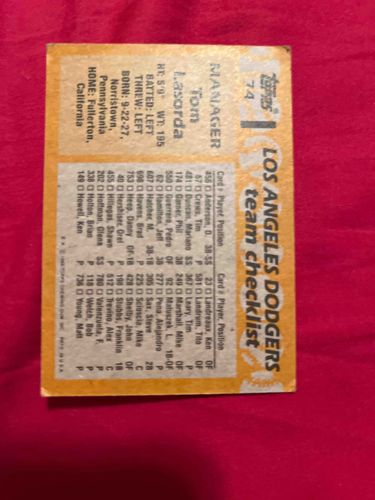
This item is the back of a vintage baseball card, specifically a 1974 Topps Los Angeles Dodgers Team Checklist. The card is rectangular, made of light-colored cardstock with a slightly textured surface, indicative of older baseball card manufacturing. The primary colors visible are cream and yellowed white for the card body, with black text, and orange and brown for the 'LOS ANGELES DODGERS team checklist' section and surrounding border. The top right corner features the yellow and orange Topps logo with '74' indicating the year of issue. The text is printed clearly, showcasing information about the team's manager, Tom Lasorda, including his height, weight, batting and throwing hands, birth date, and hometown. Below Lasorda's information, there are two columns listing player names, card numbers, and positions, which serve as a checklist. The card exhibits significant signs of wear and aging, including discoloration and yellowing characteristic of vintage paper products. The edges and corners are visibly worn, with chipping and some fraying, particularly on the top and left edges, and a noticeable ding or crease on the top left corner. This wear suggests handling and age, contributing to its patina. The overall craftsmanship is typical for mass-produced sports cards of the era, focusing on functionality over intricate design. No specific maker's marks are visible beyond the Topps logo itself, which is standard for their products. The card's condition, while showing wear, does not appear to have major tears or repairs, making the wear consistent with its age and use as a collectible.
AI Appraisal Report
Upon examining the image of this 1974 Topps Los Angeles Dodgers Team Checklist Baseball Card (Back), I can confirm its authenticity as a genuine Topps product from 1974, indicated by the '74' Topps logo. The card's design, text, and color palette are consistent with known examples of this issue.
The condition of this card is what collectors would typically categorize as "Good" to "Very Good." While the text is clear and readable, and there are no apparent tears or repairs, the significant wear evident on the edges and corners, along with the overall discoloration and yellowing, indicate considerable handling and age. The top left corner shows a noticeable crease or ding, further impacting its grade. This level of wear is common for vintage cards that were not immediately put into protective storage.
In terms of market conditions, 1974 Topps checklist cards generally hold modest value. While they are a piece of baseball history, their rarity is not exceptionally high due to their mass-produced nature. Demand is primarily from completist collectors of the 1974 Topps set, Dodgers team collectors, or those seeking nostalgic items from the era. The checklist format itself, rather than a player-specific card, often places it at a lower demand tier compared to star player cards from the same set.
Factors significantly impacting value here are primarily the condition. A card in Mint or Near Mint condition would command a much higher price due to rarity in such state. The wear present on this item significantly depresses its value.
Limitations in authenticity verification from images alone include the inability to physically inspect the cardstock for thickness, texture, or any subtle printing defects that might indicate counterfeiting (though highly unlikely for a common checklist card). An in-person examination would allow for closer scrutiny of the wear and precise corner/edge assessment. Provenance documentation, such as original wax wrappers or collector records, could add to its verified history, but is not typically expected or crucial for items of this value. Scientific testing, such as paper analysis, would be an extreme and unnecessary measure for this type of collectible.