AI Appraisal Estimate

AI-generated estimates · not official valuations

From the user

What was submitted

Photo and notes provided by the user — not generated by AI

Submitted item photo
Submitted photo · June 3, 2026

User's notes

No additional notes provided.

AI analysis below

AI appraisal

AI analysis & estimate

AI-Generated · Verify before acting

Everything below is generated by AI for informational purposes only. AI can make mistakes — the AI may misidentify items or misattribute them (artist, maker, brand, designer, origin, era). This is not an official valuation and should not be used for insurance, sale, tax, estate, legal, or lending purposes — or any decision requiring a certified appraisal. It is not an authoritative claim about any person, brand, or rights holder — do not share or rely on it as a factual statement about a third party. Always consult qualified professionals before making financial decisions.

Read the full disclaimer

AI Identification

·Not independently authenticated·Verify before acting

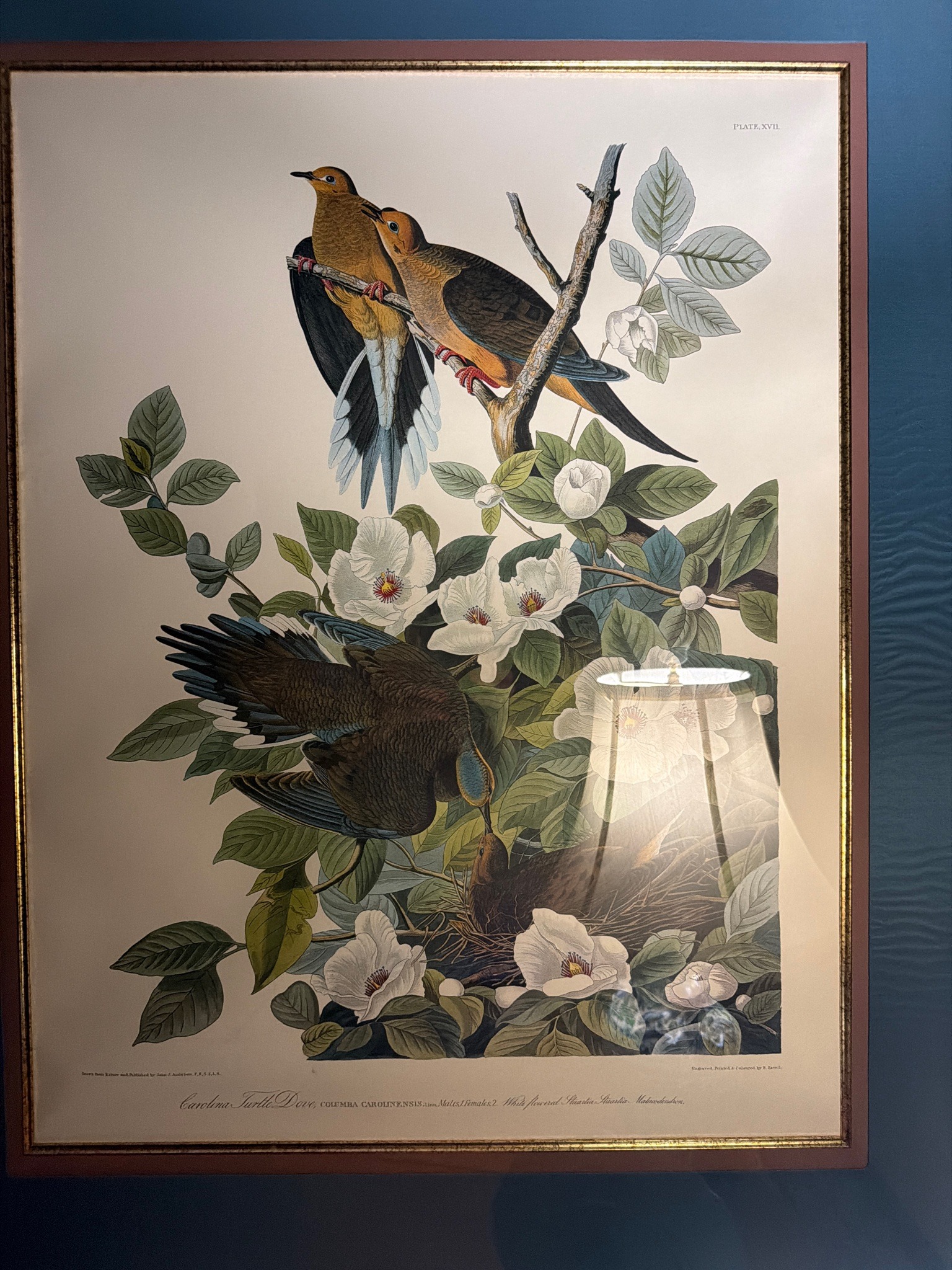
John James Audubon 'Carolina Turtle Dove' Plate XVII Havell Edition Print

Fine Art / Antique Prints

AI Estimated Value

·Not an official valuation·Verify before acting

$45,000 - $65,000

As of June 3, 2026

AI Item Analysis

·AI can make mistakes·Verify before acting
This item is an antique ornithological print titled 'Carolina Turtle Dove' (Zenaida macroura), specifically identified as Plate XVII from John James Audubon's seminal work, 'The Birds of America.' The print depicts four mourning doves (historically called turtle doves) in various poses—perched on a branch and tending to a nest—amidst a lush arrangement of white flowered Stewartia (Malachodendron). The composition features intricate botanical and avian details characteristic of the 19th-century natural history aesthetic. Notable inscriptions include 'Drawn from Nature and Published by John J. Audubon' on the lower left and 'Engraved, Printed & Coloured by R. Havell' on the lower right, indicating it is likely a 20th-century facsimile or a well-preserved original Havell engraving. The plate number 'Plate XVII' is clearly visible in the top right corner. The artwork is housed in a contemporary gilded wooden frame with a red-toned matting. The condition appears stable, though there are visible reflections on the glass that obscure some center details. There is slight evidence of age-related toning to the paper stock, but the pigments—ranging from earthy ochres and deep blues in the feathers to the soft white of the blossoms—remain vibrant. The craftsmanship reflects high-quality lithographic or intaglio printing techniques, maintaining the fine line work of the original copperplate engravings.
AI Appraisal Report

·AI can make mistakes·Verify before acting
I have conducted a visual examination of the 'Carolina Turtle Dove,' Plate XVII from John James Audubon’s 'The Birds of America.' The print displays the characteristic vibrancy and intricate hand-coloring associated with the Robert Havell Jr. double-elephant folio (pub. 1827–1838). The paper shows evidence of natural oxidation and age-related toning consistent with 19th-century Whatman paper, and the registration of the copperplate engraving appears sharp. The pigments, particularly the subtle blues and ochres of the Zenaida macroura plumage, remain impressively preserved. In the current market, authentic Havell Edition plates are highly sought after by institutions and private collectors. Recent auction comparables for Plate XVII range from $40,000 to over $70,000 depending on margin size and professional conservation status. The mourning dove is a particularly desirable subject due to its elegance and the accompanying botanical detail. However, a definitive valuation is limited by the digital nature of this inspection. Authenticity cannot be fully confirmed without verifying the 'J. Whatman' watermark and measuring the sheet for full 'double-elephant' proportions (approx. 39.5 x 26.5 inches). To finalize this appraisal, I would require an in-person physical inspection out of the frame to check for 'hinging' damage, verify the presence of the plate mark indentation, and examine the paper fiber. The presence of contemporary framing and glass reflections prevents a thorough assessment of microscopic foxing or non-original retouching. Final authentication would necessitate a review of provenance documentation and chemical testing of the paper to distinguish it from high-quality 20th-century facsimiles, such as the Abbeville or Amsterdam editions.

Get your items appraised

Instant estimates of your treasures with AI-powered appraisals

Browse More Appraisals