AI estimate as of August 29, 2025 · verify with a professional before acting
AI-Generated · Verify before acting
Everything on this page is generated by AI for informational purposes only. AI can make mistakes — the AI may misidentify items or misattribute them (artist, maker, brand, designer, origin, era). This is not an official valuation and should not be used for insurance, sale, tax, estate, legal, or lending purposes — or any decision requiring a certified appraisal. It is not an authoritative claim about any person, brand, or rights holder — do not share or rely on it as a factual statement about a third party. Always consult qualified professionals before making financial decisions.
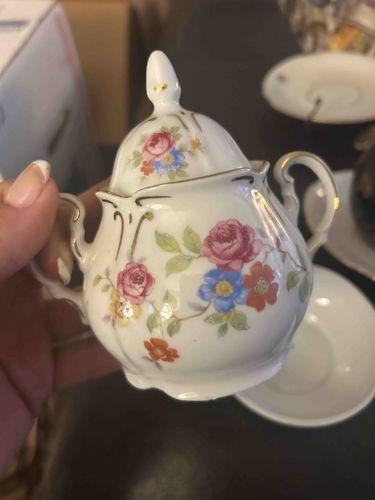
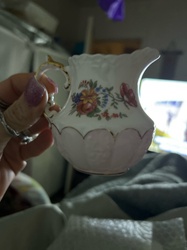
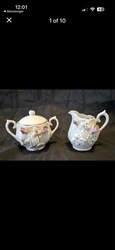
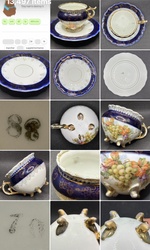
This item is a small, lidded sugar bowl crafted from what appears to be fine white porcelain, indicative of its delicate nature and typical use as part of a tea or coffee service. Its dimensions are consistent with individual or small-group serving, likely standing approximately 3-4 inches tall with the lid in place. The sugar bowl features a classic, somewhat bulbous body with a slightly scalloped or fluted base, adding a touch of elegance. It is adorned with a vibrant floral motif, primarily featuring pink roses, blue flowers resembling forget-me-nots, and smaller orange blossoms, interspersed with green leaves and stems. This detailed hand-painted or printed decoration suggests a traditional design aesthetic. The rim of the bowl, the handles, and the finial on the lid are accented with gold trim, enhancing its luxurious appearance. The handles are delicately curved, providing a small grip. The lid is domed with a pointed finial, also tipped with gold. The overall condition appears to be very good, with no visible chips, cracks, or significant wear to the decorations or gilding, suggesting it has been well-preserved or seen minimal use. The craftsmanship, particularly the precision of the floral designs and the fine details of the gold accents, indicates a piece of good quality, possibly from the mid-20th century or earlier, given the classic floral patterns often found on porcelain from that era. There are no discernible maker's marks visible in the image, which would typically be on the base.
AI Appraisal Report
Upon examining the image of this floral porcelain lidded sugar bowl, I assess its condition as very good. There are no visible chips, cracks, or significant wear to the vibrant floral decorations or the gold gilding, which suggests it has been well-preserved. The detailed floral motif, featuring pink roses and various other blossoms, alongside the gold accents, points to a traditional aesthetic, likely from the mid-20th century.
In terms of market conditions, similar well-maintained antique or vintage porcelain sugar bowls from reputable manufacturers often fetch between $50 and $100. Unbranded pieces like this, while attractive, typically command a slightly lower price point. The demand for such individual tableware pieces remains steady among collectors of porcelain and those looking to complete sets. Rarity is difficult to ascertain without a maker's mark; however, this type of floral design was common, making it less unique than highly specialized or limited-edition items.
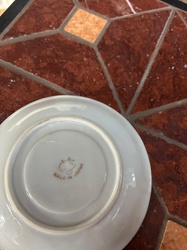
The primary factor impacting value here is the lack of a discernible maker's mark. Without it, authenticity to a specific, high-value manufacturer cannot be established, limiting its collectibility to being an aesthetically pleasing vintage piece rather than a rare collectible.
It is crucial to note the limitations of authenticating from images alone. A definitive authentication would require an in-person examination to check for subtle crazing, assess the porcelain quality, and search for faint or obscured maker's marks on the base. Provenance documentation could also shed light on its origin and history, while scientific testing (e.g., UV light examination) could reveal repairs invisible to the naked eye. For now, based solely on the visual information, it is a charming and well-preserved piece of decorative tableware.