AI estimate as of August 9, 2025 · verify with a professional before acting
AI-Generated · Verify before acting
Everything on this page is generated by AI for informational purposes only. AI can make mistakes — the AI may misidentify items or misattribute them (artist, maker, brand, designer, origin, era). This is not an official valuation and should not be used for insurance, sale, tax, estate, legal, or lending purposes — or any decision requiring a certified appraisal. It is not an authoritative claim about any person, brand, or rights holder — do not share or rely on it as a factual statement about a third party. Always consult qualified professionals before making financial decisions.
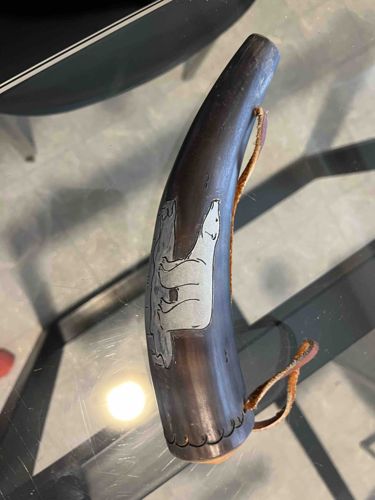
This item is a decorative powder horn or a similar vessel, likely crafted from an animal horn, given its curved, tapering form and dark, polished surface. It measures approximately 10-12 inches in length, exhibiting a rich, dark brown, almost black, hue with visible striations inherent to horn material. A leather thong or strap, light brown in color, is attached near the narrower, open end, suggesting it was designed to be carried or hung. The most prominent feature is the carved or inlaid decoration on one side, depicting a scene with what appears to be a mother polar bear and a cub, rendered in a light, possibly white or silver, material that contrasts sharply with the dark horn. The style of the animals suggests Indigenous or Inuit artistry, characterized by fluid lines and a simplified, yet expressive, representation. The wider base of the horn shows a lighter wood or cork stopper, which appears to be carved with a stylized wavy or scalloped border around its circumference, adding a decorative touch and securing the contents. The surface generally appears smooth and well-preserved, with a gentle sheen indicating careful handling or polishing. There are no immediate visible signs of significant damage like cracks or chips, though minor surface wear consistent with age and use may be present, contributing to its patina. The craftsmanship appears to be of good quality, with attention to detail in the animal carvings and the fitting of the base. The lack of distinct manufacturing marks makes precise dating difficult, but its aesthetic suggests a 20th-century folk art piece, possibly originating from regions with rich Indigenous cultures known for their animal motif artistry.
AI Appraisal Report
Based on my visual examination of the provided image, this carved animal horn, functioning possibly as a powder horn or decorative vessel, appears to be in very good condition. The dark, polished surface of the horn shows no obvious cracks or chips, and the integrated leather thong seems intact. The most compelling feature is the carved or inlaid scene of a mother polar bear and cub, which displays a clear Indigenous or Inuit artistic influence. The contrast between the light animal figures and the dark horn is striking, and the carving detail suggests skilled craftsmanship. The wooden or cork stopper at the base also adds to its decorative appeal.
From the image alone, authenticity as a historical, utilitarian powder horn is difficult to ascertain, though its decorative quality is evident. It strongly presents as a 20th-century folk art piece, given the stylistic representation and general appearance. The demand for well-executed Indigenous or Inuit-inspired folk art is consistent, but rarity for such decorative horns is not exceptionally high unless directly attributable to a known artist or specific community. Comparables include other carved folk art items, particularly those featuring animal motifs from northern regions, which typically fall into a moderate price range.
Limitations in authentication are significant without physical inspection. I cannot confirm the exact material of the horn (e.g., bovine, other animal), the inlay material, or the age of the horn itself. An in-person examination would allow me to assess the tactile quality of the horn, the precision of the carving, and the method of inlay. Provenance documentation, if available, linking it to a specific artist, region, or time period, would substantially impact its value. Scientific testing could verify material composition and age, but for a piece of this nature, that would likely be disproportionately expensive relative to its inherent value. Without such documentation or physical inspection, I am appraising it solely as a decorative folk art object based on its visual appeal and craftsmanship.