AI Appraisal Estimate

AI-generated estimates · not official valuations

From the user

What was submitted

Photo and notes provided by the user — not generated by AI

Submitted item photo
Submitted photo · May 27, 2026

User's notes

No additional notes provided.

AI analysis below

AI appraisal

AI analysis & estimate

AI-Generated · Verify before acting

Everything below is generated by AI for informational purposes only. AI can make mistakes — the AI may misidentify items or misattribute them (artist, maker, brand, designer, origin, era). This is not an official valuation and should not be used for insurance, sale, tax, estate, legal, or lending purposes — or any decision requiring a certified appraisal. It is not an authoritative claim about any person, brand, or rights holder — do not share or rely on it as a factual statement about a third party. Always consult qualified professionals before making financial decisions.

Read the full disclaimer

AI Identification

·Not independently authenticated·Verify before acting

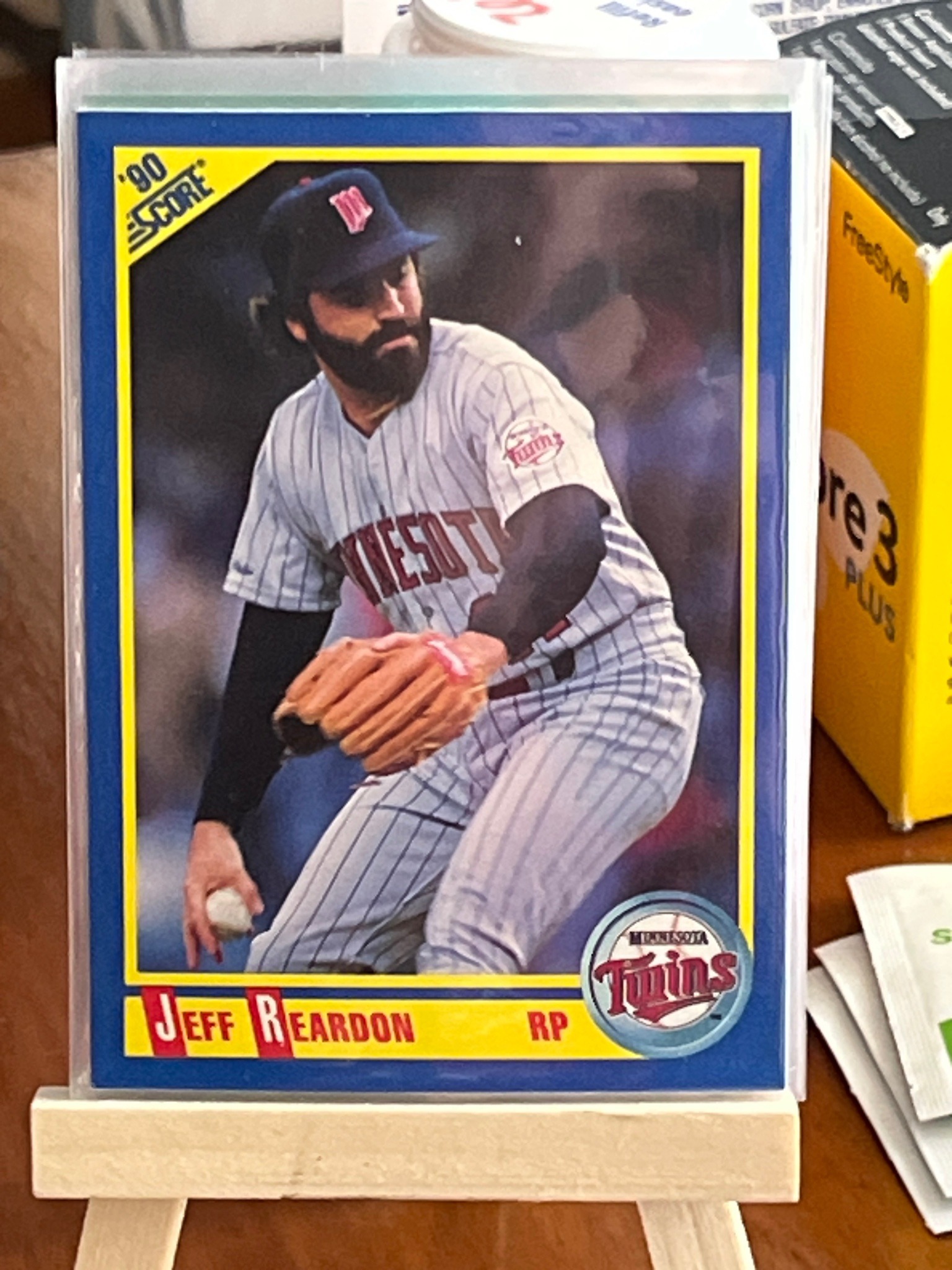
1990 Score Jeff Reardon Baseball Card #201

Sports Memorabilia / Baseball Cards

AI Estimated Value

·Not an official valuation·Verify before acting

$0.05 - $0.50

As of May 27, 2026

AI Item Analysis

·AI can make mistakes·Verify before acting
This is a standard 2.5 by 3.5-inch trading card featuring relief pitcher Jeff Reardon of the Minnesota Twins, produced by Score in 1990. The card showcases a vibrant design characteristic of early 90s sports collectibles, featuring a thick blue outer border and a bright yellow inner frame. The '90 Score' logo is prominently displayed in the upper-left corner. The central image depicts Reardon in his home pinstripe Minnesota Twins uniform, sporting his iconic full beard and a dark navy blue team cap. At the bottom, his name is printed in red lettering on a yellow bar, alongside the position abbreviation 'RP'. The Minnesota Twins team logo is located in a circular badge at the bottom right. The card is currently housed in a clear protective semi-rigid sleeve or top-loader, which is resting on a miniature wooden display easel. Visually, the card appears to be in very good to excellent condition, with crisp color saturation and relatively sharp corners visible through the sleeve. There are no obvious signs of surface scratching, creasing, or significant edge wear noticeable in the photograph, though the top centering appears slightly biased toward the top edge. The manufacturing materials consist of standard cardstock with a glossy front finish and a matte reverse (not visible).
AI Appraisal Report

·AI can make mistakes·Verify before acting
I have conducted a visual examination of the 1990 Score Jeff Reardon #201. The card is presented in a protective top-loader and appears to be in Near Mint (NM) condition. The registration is sharp, and the characteristic blue and yellow borders remain vibrant without evidence of light fading. However, a slight top-to-bottom centering bias is noted, with the top border appearing thinner than the bottom. While the corners appear sharp through the plastic, a definitive grade cannot be assigned without inspecting the surface for wax staining or micro-indentations common to this era. From a market perspective, this card belongs to the 'Junk Wax Era' (1987–1994), characterized by massive overproduction. Jeff Reardon was an elite closer and a four-time All-Star, but his cards from mass-produced sets like 1990 Score do not command a premium. Current market comparables show that individual base cards from this set typically sell for a few cents in bulk or up to fifty cents as singles to collectors completing sets. Even in a high-grade professional slab (PSA 10), the value rarely exceeds $15–$20, which often falls below the cost of the grading fee itself. Critically, a visual inspection via image cannot verify cardstock density or detect sophisticated trimming or surface pressing. To provide a definitive authentication, I would require a physical examination under 10x magnification to verify the 'rosette' printing pattern and a blacklight test to ensure the paper stock reacts correctly for 1990 production. Given the low market value, the card is assumed authentic as the cost of counterfeiting would far exceed the market price.

Get your items appraised

Instant estimates of your treasures with AI-powered appraisals

Browse More Appraisals