These notes were written by the person who submitted this item. Appraiser.AI has not verified them, and the AI's identification and estimate may rely on them.
AI Estimated Value
Not an official valuation
$250-400
AI estimate as of October 12, 2025 · verify with a professional before acting
AI-Generated · Verify before acting
Everything on this page is generated by AI for informational purposes only. AI can make mistakes — the AI may misidentify items or misattribute them (artist, maker, brand, designer, origin, era). This is not an official valuation and should not be used for insurance, sale, tax, estate, legal, or lending purposes — or any decision requiring a certified appraisal. It is not an authoritative claim about any person, brand, or rights holder — do not share or rely on it as a factual statement about a third party. Always consult qualified professionals before making financial decisions.
This analysis also relies on unverified notes provided by the user, which may be incomplete or inaccurate and could affect the result.
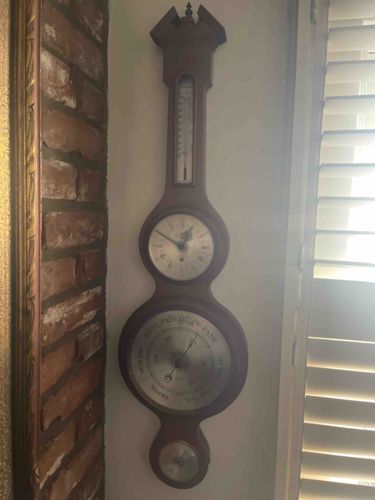
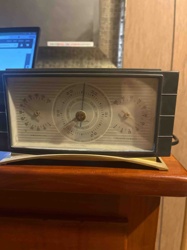
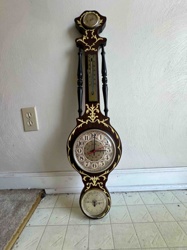
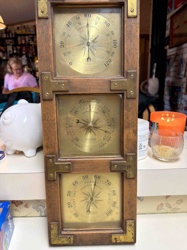
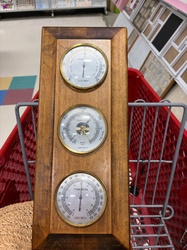
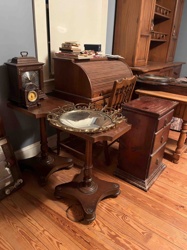
This item is an antique or vintage banjo-shaped weather station, comprising a barometer, clock, and thermometer, all housed within a single wooden case. The case appears to be made of a dark-stained hardwood, possibly mahogany or walnut, showcasing a rich, warm tone. Its distinct banjo or ‘stick’ shape is characteristic of traditional barometers, with a decorative carved pediment at the top, adding an elegant touch. From top to bottom, the piece features a vertical thermometer with a mercury (or alcohol-based) column, indicating temperature. Below this, a circular clock with a white face and Roman or Arabic numerals (difficult to discern clearly) displays the time. Further down, the largest circular dial is a barometer, marked with weather indications such as 'CHANGEABLE,' 'FAIR,' and 'STORM,' with a central hand for pressure readings. At the very bottom, a smaller, circular dial, likely a hygrometer (to measure humidity) or a second thermometer, completes the ensemble. The metal bezels around the dials appear to be brass or a similar polished metal, showing a potential patina consistent with age. No obvious major damage like cracks or significant chips in the wood are visible, although minor surface wear or scratches may be present, typical of an aged piece. The overall craftsmanship suggests a mass-produced, yet well-finished, decorative and functional instrument from the late 19th or early 20th century. Visible quality indicators include the uniform finish of the wood and the clear delineation of the instrument dials. No specific maker's marks or signatures are discernible from the image.
AI Appraisal Report
Based on my visual examination of the provided image, this banjo-shaped weather station, incorporating a barometer, clock, and thermometer, presents as a well-preserved antique or vintage piece. The dark-stained hardwood case, likely mahogany or walnut, shows a consistent finish and decorative carved pediment, indicative of mass-produced yet quality craftsmanship from the late 19th to early 20th century. The metal bezels, likely brass, show an expected patina consistent with age. I observe no major damage like cracks or chips; however, general surface wear or minor scratches are probable given its age.
Market conditions for such items are generally stable, with demand driven by decorative appeal and collectors of scientific instruments. Comparables often fall into the mid-range for antique barometers due to the inclusion of multiple functions. While not exceedingly rare, pieces in good visual condition like this hold their value. Factors positively impacting value include the multi-functionality and apparent good aesthetic condition. The absence of specific maker's marks or signatures, however, limits its upward potential.
It is crucial to note that my assessment of authenticity and condition is based solely on visual interpretation of the image. For full authentication and a more precise valuation, a physical examination is indispensable. This would allow me to thoroughly inspect the wood species, assess the operational condition of the clock, barometer, and thermometer mechanisms, verify the presence of mercury or alcohol in the thermometer, and search for any hidden maker's marks or restoration work. Provenance documentation, if available, would also significantly enhance authenticity verification, as would scientific testing of materials if any alterations or reproductions were suspected.