These notes were written by the person who submitted this item. Appraiser.AI has not verified them, and the AI's identification and estimate may rely on them.
AI Estimated Value
Not an official valuation
$60-100
AI estimate as of July 18, 2025 · verify with a professional before acting
AI-Generated · Verify before acting
Everything on this page is generated by AI for informational purposes only. AI can make mistakes — the AI may misidentify items or misattribute them (artist, maker, brand, designer, origin, era). This is not an official valuation and should not be used for insurance, sale, tax, estate, legal, or lending purposes — or any decision requiring a certified appraisal. It is not an authoritative claim about any person, brand, or rights holder — do not share or rely on it as a factual statement about a third party. Always consult qualified professionals before making financial decisions.
This analysis also relies on unverified notes provided by the user, which may be incomplete or inaccurate and could affect the result.
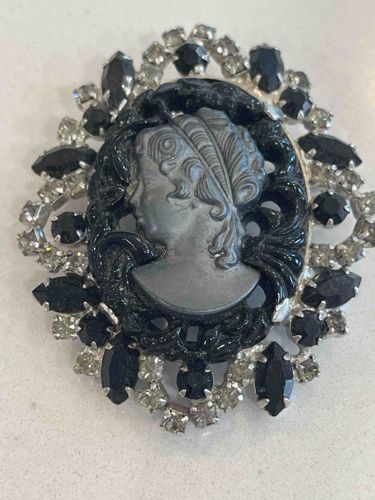
This is an antique or vintage cameo brooch, featuring a central oval-shaped cameo set within an ornate, multi-gemstone frame. The cameo itself depicts the profile of a woman's head and shoulders, carved in a light grey material, possibly a form of plastic, resin, or molded glass, against a darker, possibly black, background. The carving detail on the woman's hair and drapery is visible, suggesting a certain level of craftsmanship. The outer frame is composed of numerous faceted rhinestones and larger black glass stones, arranged in a scalloped or floral pattern. The black stones are predominantly marquise cuts and round cuts, creating a striking contrast with the clear rhinestones, which appear to be round or cushion cut. The metal setting supporting these stones is silver-toned, likely base metal given the era, and shows some signs of darkening or patina in the crevices, indicating age. There might be some wear on the facets of the rhinestones, consistent with an item of this age. The overall construction appears sturdy, with stones set securely, though specific setting types are not entirely clear from the image. This piece is likely from the Art Deco to Mid-Century period, possibly 1920s-1950s, given the style of the cameo and the use of rhinestones and glass. The craftsmanship, while not fine jewelry grade, indicates a well-made costume piece designed for decorative impact.
AI Appraisal Report
Upon my virtual examination of this Vintage Black and Clear Rhinestone Cameo Brooch, I assess it as a well-preserved costume jewelry piece likely from the 1920s-1950s, aligning with the Art Deco to Mid-Century period. The central cameo, depicting a woman's profile, appears to be made of molded material—either plastic, resin, or glass—and showcases decent detail. Its authenticity as an antique is supported by the overall style and visible signs of age, such as the patina on the silver-toned base metal setting. The numerous clear and black rhinestones, predominantly marquise, round, and cushion cuts, contrast effectively, although some wear on the facets is expected given its age. All stones appear securely set, suggesting sturdy construction typical for quality costume pieces of the era.
In terms of market conditions, vintage costume jewelry, especially pieces with a distinctive cameo and ornate rhinestone work, currently enjoys steady demand among collectors and enthusiasts of historical fashion. While not fine jewelry, its aesthetic appeal and historical context contribute to its desirability. Rarity is moderate; similar costume cameos exist, but the specific combination of black and clear rhinestones in such an elaborate setting is less common than simpler designs. Factors impacting value include its good condition, detailed craftsmanship, and appealing design. However, the use of base metal and rhinestones rather than precious metals and gemstones limits its intrinsic material value. For full authentication, particularly regarding the cameo material and exact age, an in-person examination would be crucial. Scientific testing (e.g., UV light for plastic identification) or provenance documentation (e.g., original sales receipts, family history) would provide definitive answers about materials and authenticity that cannot be determined from images alone.