These notes were written by the person who submitted this item. Appraiser.AI has not verified them, and the AI's identification and estimate may rely on them.
AI Estimated Value
Not an official valuation
$250 - $400
AI estimate as of September 25, 2025 · verify with a professional before acting
AI-Generated · Verify before acting
Everything on this page is generated by AI for informational purposes only. AI can make mistakes — the AI may misidentify items or misattribute them (artist, maker, brand, designer, origin, era). This is not an official valuation and should not be used for insurance, sale, tax, estate, legal, or lending purposes — or any decision requiring a certified appraisal. It is not an authoritative claim about any person, brand, or rights holder — do not share or rely on it as a factual statement about a third party. Always consult qualified professionals before making financial decisions.
This analysis also relies on unverified notes provided by the user, which may be incomplete or inaccurate and could affect the result.
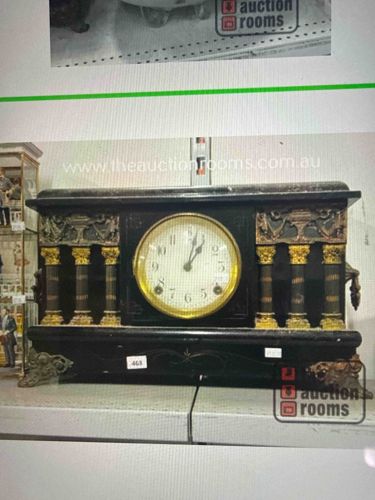
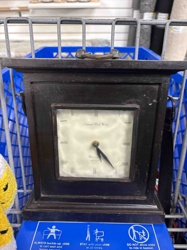
This is a mantel clock, likely of American manufacture, dating to the late 19th century, possibly between 1880 and 1900. The clock features a substantial, rectangular case constructed from wood, finished in a dark, ebonized color, giving it a formal and somewhat somber aesthetic. The overall design incorporates architectural elements, characteristic of the Neoclassical or Aesthetic Movement revivals often seen in mantel clocks of this period. The central clock face is circular, with a brass or gold-toned bezel, indicating it is likely brass. The dial is white or off-white with black Arabic numerals for hour markers and two distinct black hands for hours and minutes. The face appears to be glass-covered. Flanking the clock dial on either side are decorative panels featuring ornate, possibly cast metal, elements in a gilded finish, which contrasts sharply with the dark case. Below these panels are four fluted columns, two on each side, also ebonized with gilded capitals and bases, echoing classical architectural styles. The base of the clock features subtle gilded scrollwork or decorative motifs at the corners, and a central, more abstract gilded design, possibly a stylized star or emblem. The visible condition suggests some wear consistent with age, including possible minor scuffs or chips to the ebonized finish, and perhaps some dulling or tarnishing to the gilded elements, though these appear to retain much of their luster. There are no obvious signs of major damage or significant repairs visible in the image. A white sticker with '463' is affixed to the front base, likely an inventory or auction lot number. The craftsmanship appears solid, emphasizing a blend of mass-produced components (like the case and decorative elements) with a functional clock mechanism. This type of clock would have been a significant household item in its era, providing both timekeeping and decorative value.
AI Appraisal Report
Based on my visual examination of the provided image, this Late 19th-Century American Mantel Clock presents as a fine example of its type, likely dating from 1880 to 1900. The ebonized wooden case with architectural elements, gilded panels, and fluted columns is characteristic of the Neoclassical or Aesthetic Movement influence prevalent in American clockmaking during this period. The brass bezel, white dial with Arabic numerals, and dark hands align with typical manufacturing practices of the era.
From the image, the condition appears good for its age, displaying wear consistent with a century of existence, including what seem to be minor scuffs or chips to the ebonized finish and some possible tarnishing on the gilded highlights. These elements contribute to its authentic patina rather than detracting significantly from its value. The '463' sticker is likely an inventory mark and does not impact intrinsic value.
In terms of market conditions, American mantel clocks of this period are generally desirable among collectors of antique timepieces and decorative arts. However, the market for mass-produced, though well-made, examples like this tends to be stable rather than experiencing sharp increases. Demand is moderate, with rarity not being a significant factor for this specific style.
Factors significantly impacting value include the functional condition of the clock mechanism, the originality of all components (dial, hands, movement), and the overall preservation of the finish. Without an in-person examination, I cannot definitively comment on the mechanical integrity, the presence of original components, or the extent of any repairs or restoration. A full authentication would require physical inspection to assess the movement's maker and condition, verify the originality of all parts, and determine the extent of any prior restoration. Provenance documentation, though rarely available for such clocks, could also add to its value.