AI estimate as of December 11, 2025 · verify with a professional before acting
AI-Generated · Verify before acting
Everything on this page is generated by AI for informational purposes only. AI can make mistakes — the AI may misidentify items or misattribute them (artist, maker, brand, designer, origin, era). This is not an official valuation and should not be used for insurance, sale, tax, estate, legal, or lending purposes — or any decision requiring a certified appraisal. It is not an authoritative claim about any person, brand, or rights holder — do not share or rely on it as a factual statement about a third party. Always consult qualified professionals before making financial decisions.
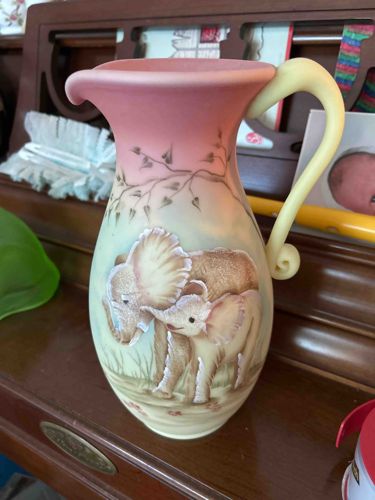
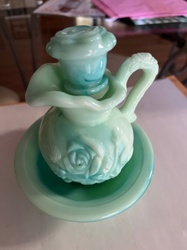
This item is a decorative pitcher or vase, notable for its hand-painted scene featuring elephants and an applied, sculptural handle. The body of the vessel is crafted from what appears to be satin glass or opalescent glass, exhibiting a smooth, matte finish. The color transitions from a vibrant rose-pink at the flared rim and upper neck, gradually blending into a softer peach or cream tone around the middle, and then into a muted light green or pale yellow at the base. The hand-painted decoration depicts an idyllic savanna scene, with light brown tree branches and foliage subtly sketched near the upper part of the body. The central and most prominent feature is a raised, three-dimensional portrayal of two elephants, likely a mother and calf, rendered in shades of beige and brown with textured details suggesting their hide. They are situated in a grassy landscape with delicate, small red or pink floral elements scattered at the base. The handle is a distinct, light yellow, possibly opaque glass, applied separately to the body. It features a curved, organic shape with a decorative swirl at its lower attachment point. The rim of the pitcher is slightly undulating and fluted, adding to its ornamental appeal. The overall condition appears good, with no immediately visible chips, cracks, or significant wear to the paintwork based on the provided images. The craftsmanship suggests it is a studio art piece or a quality decorative item, possibly from the late 19th or early 20th century, given the style of painted glass, or a more contemporary piece mimicking that aesthetic. The raised elephant figures are a unique and distinguishing element, indicating a higher level of artistic detail and manufacturing complexity.
AI Appraisal Report
Upon visual examination of the provided image, I assess this Hand-Painted Elephant Motif Pitcher/Vase to be in very good overall condition. There are no readily apparent chips, cracks, or significant abrasions to the glass or painted decoration. The colors remain vibrant, and the applied handle appears securely attached. Authenticity, based solely on imagery, is challenging; however, the style strongly suggests a late 19th to early 20th-century art glass piece, possibly European or American studio art glass, or a more contemporary piece expertly mimicking that aesthetic. The raised, three-dimensional elephants are a significant and unique artistic feature, adding considerable visual interest and suggesting a higher level of craftsmanship than typical painted glass.
In terms of market conditions, decorative opaque or satin art glass from this period, especially with intact, detailed hand-painting and unusual applied elements, commands moderate to strong interest from collectors. Comparables would include pieces by makers known for hand-painted scenic or figural designs on colored or satin glass. Demand for pieces with animal motifs, particularly elephants, is generally stable. Rarity is enhanced by the distinctive raised elephant figures. Factors significantly impacting value include the excellent condition, the artistic quality of the painting, and the unique sculptural application of the elephants and handle. Were this piece definitively attributable to a known maker or studio, its value could increase substantially.
Limitations in authenticity verification from images alone are considerable. I cannot assess the precise material composition (e.g., true satin glass, pressed glass with a frosted finish), manufacturing techniques, or detect subtle repairs or hidden damage. A physical inspection would allow for examination of the base, pontil mark (if any), glass quality, and paint thickness under magnification. Provenance documentation, such as original purchase receipts or exhibition history, would be crucial for full authentication and attribution. Scientific testing, such as spectroscopy, could confirm glass composition and age but is rarely practical for decorative items of this nature unless a high-value attribution is suspected.