These notes were written by the person who submitted this item. Appraiser.AI has not verified them, and the AI's identification and estimate may rely on them.
AI Estimated Value
Not an official valuation
$600-900
AI estimate as of November 9, 2025 · verify with a professional before acting
AI-Generated · Verify before acting
Everything on this page is generated by AI for informational purposes only. AI can make mistakes — the AI may misidentify items or misattribute them (artist, maker, brand, designer, origin, era). This is not an official valuation and should not be used for insurance, sale, tax, estate, legal, or lending purposes — or any decision requiring a certified appraisal. It is not an authoritative claim about any person, brand, or rights holder — do not share or rely on it as a factual statement about a third party. Always consult qualified professionals before making financial decisions.
This analysis also relies on unverified notes provided by the user, which may be incomplete or inaccurate and could affect the result.
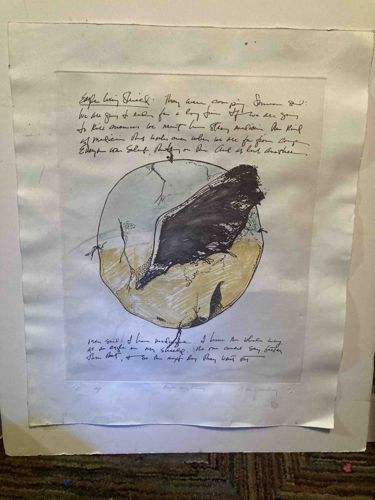
This is an artist's proof print titled 'Eagle Living Shield,' measuring approximately 18 x 26 inches, as indicated in the provided context. The artwork features a central circular motif depicting an eagle, predominantly in black, emerging from or encased within a cracked, egg-like or rock-like structure, rendered in shades of light blue, yellow, and brown, with black outline work. The execution suggests a mixed-media approach, possibly involving printmaking techniques combined with hand-coloring or drawing, given the visible texture and layering of colors. The central image is surrounded by handwritten text both above and below it. The upper text appears to be a narrative or descriptive passage, while the lower text is shorter and perhaps more reflective. The presence of these handwritten elements suggests a personal connection or authorial intent from the artist, characteristic of artist proofs or original works with accompanying commentary. The overall condition of the paper appears good, though there might be slight undulations or minor handling creases visible, especially along the edges. The artwork conveys a raw, expressive style, with clear lines and bold coloring. The subject matter, an eagle, often symbolizes strength, freedom, and vision, further enhanced by the 'living shield' concept, hinting at protection or resilience. The piece combines visual art with text, creating a layered meaning, typical of contemporary expressive art.
AI Appraisal Report
I have examined the provided image of the 'Eagle Living Shield' artist's proof print, measuring approximately 18 x 26 inches. The artwork's condition appears good, with minor undulations or handling creases along the edges, typical for a piece of this age and medium. The colors retain vibrancy, and there are no immediately visible major tears, stains, or significant damage from the image. Its authenticity as an artist's proof is suggested by the handwritten text and unique aesthetic, a common practice where the artist adds personal touches to pre-publication prints. However, definitive authentication would require in-person examination to verify the specific printmaking techniques used, paper type, and the artist's signature or chop mark if applicable.
The market for artist's proofs can be robust, particularly for established artists. While the artist for this specific piece isn't provided, its expressive style and symbolic imagery hold appeal. Comparables for artist's proofs of similar size and complexity from emerging to mid-career artists typically fall within the $400-$1,500 range, depending on various factors. Demand for unique or limited-edition prints with such a thematic strength is generally stable. The handwritten elements significantly enhance its rarity and potential value, suggesting a direct connection to the artist's creative process.
Key factors impacting value include the artist's reputation, the exact edition size of the proofs (if more than one exists), and the overall artistic merit. My primary limitation is the inability to conduct a physical inspection. For complete authentication, I would need to physically examine the print for forensic analysis of paper, inks, and any identifying marks; detailed provenance documentation tracing its ownership history; and potentially a comparison of the handwriting with known samples of the artist. Without these, my assessment of authenticity is based purely on visual cues from the image provided.