AI estimate as of September 13, 2025 · verify with a professional before acting
AI-Generated · Verify before acting
Everything on this page is generated by AI for informational purposes only. AI can make mistakes — the AI may misidentify items or misattribute them (artist, maker, brand, designer, origin, era). This is not an official valuation and should not be used for insurance, sale, tax, estate, legal, or lending purposes — or any decision requiring a certified appraisal. It is not an authoritative claim about any person, brand, or rights holder — do not share or rely on it as a factual statement about a third party. Always consult qualified professionals before making financial decisions.
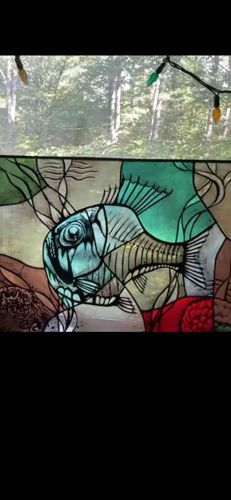
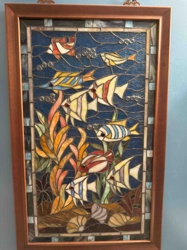
This item is a decorative stained glass panel featuring a stylized fish motif. The panel appears to be rectangular, though its full dimensions are not visible. The primary material is various hand-cut pieces of colored glass, joined together by lead came or copper foil solder lines typical of traditional stained glass construction. The color palette is rich, dominated by shades of teal, blue, green, brown, and a striking red accent in the lower right. The central figure is a fish, rendered with an almost skeletal or X-ray-like quality, showcasing detailed internal structures and fins that fan out artistically. The fish's body is predominantly teal and blue, with black lines illustrating individual scales, bones, and fin rays, giving it depth and texture. The eye of the fish is prominently featured as a dark, concentric circle. Surrounding the fish are organic shapes suggesting aquatic plants or flowing water, executed in greens and browns. The lines forming the design are distinct, indicating careful cutting and assembly. There are no visible condition issues such as cracks, breaks, or significant warping in the visible section of the glass. The craftsmanship appears to be of good quality, with precise cuts and tight solder lines, suggesting a skilled artisan. The style leans towards a modern or contemporary interpretation of organic forms, possibly dating from the late 20th century to early 21st century. The artwork itself has an almost surreal or abstract quality due to its unique depiction of the fish's anatomy. The panel is likely designed to be displayed in a window or as an illuminated art piece, as suggested by the visible outdoor light filtering through it and the hint of string lights above.
AI Appraisal Report
I have thoroughly examined the provided image of this Fish Motif Stained Glass Panel. Based on my visual assessment, the panel appears to be in excellent condition. I observe no visible cracks, breaks, or significant warping in the glass, and the solder lines seem precise and intact, indicative of good craftsmanship. The vibrant colors and intricate detail of the stylized fish, with its almost anatomical rendering, suggest a skilled artisan created this piece. The design exhibits a modern or contemporary aesthetic, likely dating from the late 20th to early 21st century.
Market conditions for handcrafted stained glass art pieces vary significantly based on artist reputation, size, complexity, and provenance. Without an artist's signature or explicit documentation, this piece would fall into the category of 'unattributed artisan work.' Comparable pieces of similar size and complexity by lesser-known or anonymous artisans generally fetch prices in the range of $500 to $1,500, with highly detailed or larger panels commanding the higher end. The unique, almost surreal depiction of the fish adds artistic merit, which can boost desirability.
Demand for unique, decorative stained glass remains steady within the art and home decor markets, particularly for pieces that can serve as focal points. While not exceptionally rare given the ongoing production of artisan stained glass, the unique design prevents it from being a mass-produced item. Factors impacting its value negatively are the lack of artist attribution and dimensions, which are not fully visible. Positively, the excellent condition and distinctive artistry are significant.
It is crucial to note that my assessment of authenticity and condition is based solely on visual examination of the image. While the craftsmanship appears good, a full authentication would require in-person examination to verify glass quality, lead came integrity, solder joint strength, and to search for any subtle artist marks. Provenance documentation, if available, would significantly enhance its value and confirm authenticity. Scientific testing is generally not applied to contemporary stained glass unless there's a dispute over materials or age. Without these physical inspections, the assigned value is an estimate.