AI Appraisal Estimate

AI-generated estimates · not official valuations

From the user

What was submitted

Photo and notes provided by the user — not generated by AI

Submitted item photo
Submitted photo · May 25, 2026

User's notes

No additional notes provided.

AI analysis below

AI appraisal

AI analysis & estimate

AI-Generated · Verify before acting

Everything below is generated by AI for informational purposes only. AI can make mistakes — the AI may misidentify items or misattribute them (artist, maker, brand, designer, origin, era). This is not an official valuation and should not be used for insurance, sale, tax, estate, legal, or lending purposes — or any decision requiring a certified appraisal. It is not an authoritative claim about any person, brand, or rights holder — do not share or rely on it as a factual statement about a third party. Always consult qualified professionals before making financial decisions.

Read the full disclaimer

AI Identification

·Not independently authenticated·Verify before acting

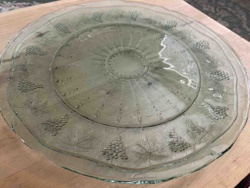
Vintage Pressed Glass Sunburst or Scalloped Pedestal Cake Stand

Vintage Glassware & Kitchenware

AI Estimated Value

·Not an official valuation·Verify before acting

$45.00 - $65.00

As of May 25, 2026

AI Item Analysis

·AI can make mistakes·Verify before acting
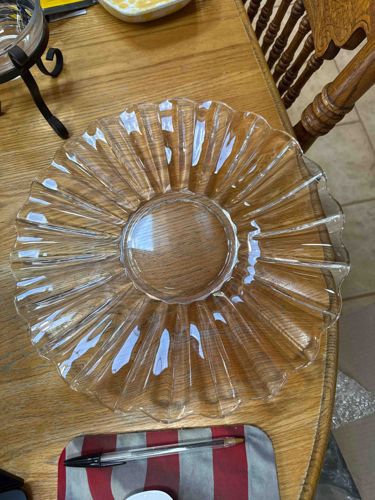
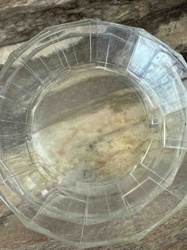
This is a circular, transparent glass serving piece, identified as a pedestal-style cake plate or platter. The design features a prominent 'sunburst' or radial rib pattern, consisting of numerous fluted wedges that extend from a smooth, circular central hub to a scalloped or wavy outer rim. The construction is heavy pressed glass, characteristic of Mid-Century Modern or late Depression-era glassware, likely dating from the 1940s to the 1960s. The glass appears to have excellent clarity with high light refraction along the molded ridges. The foot of the stand is not fully visible from this top-down perspective, but typical examples of this style feature a short, thick pedestal base. Regarding condition, the piece shows minor surface scratches consistent with use, particularly in the central flat area where a cake knife would have made contact. There are no visible major chips, cracks, or discoloration in this lighting. The craftsmanship is utilitarian yet elegant, with no obvious mold seam defects, suggesting a mass-market production by a notable manufacturer like Anchor Hocking (Fairfield pattern) or Federal Glass. The scalloped edge is a distinguishing feature that provides both aesthetic flair and structural rigidity to the wide diameter of the plate.
AI Appraisal Report

·AI can make mistakes·Verify before acting
Based on my visual examination of this vintage pressed glass cake stand, I have identified it as a mid-20th-century piece, most likely the 'Fairfield' pattern by Anchor Hocking or a similar production by Federal Glass, dating circa 1950-1965. The sunburst radial pattern and scalloped rim indicate a transition between Late Depression era aesthetics and the Mid-Century Modern utility. The glass possesses high clarity, and the wear patterns—specifically the light surface scratching in the central hub—are consistent with authentic domestic use rather than contemporary reproduction. The market for mid-market American pressed glass remains stable but modest. Similar pedestal stands frequently appear in regional auctions and online marketplaces. While the scalloped edge adds a 'fancy' touch that appeals to collectors of 'shabby chic' or vintage kitchenware, these were mass-produced items, making them relatively common. Its value is driven primarily by its functional decorative appeal rather than extreme rarity. Several factors impact this valuation. The lack of major chips on the scalloped edges is a significant positive, as these points are prone to damage. However, the visible 'knife marks' prevent it from reaching 'mint' collectors' pricing. Limits to this digital appraisal include the inability to inspect for 'straw marks,' internal bubbles, or manufacturer marks on the base, which are often faint. To finalize authentication, I would require a physical inspection to check for mold seam smoothness and a UV light test to check for the presence of manganese or other additives common in specific glass eras. Provenance regarding its purchase history or original boxing would also potentially bolster the secondary market value.

Get your items appraised

Instant estimates of your treasures with AI-powered appraisals

Browse More Appraisals