AI estimate as of November 19, 2025 · verify with a professional before acting
AI-Generated · Verify before acting
Everything on this page is generated by AI for informational purposes only. AI can make mistakes — the AI may misidentify items or misattribute them (artist, maker, brand, designer, origin, era). This is not an official valuation and should not be used for insurance, sale, tax, estate, legal, or lending purposes — or any decision requiring a certified appraisal. It is not an authoritative claim about any person, brand, or rights holder — do not share or rely on it as a factual statement about a third party. Always consult qualified professionals before making financial decisions.
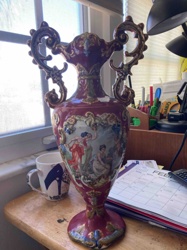
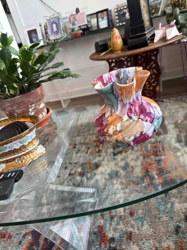
This exquisite item is a ceramic or porcelain pitcher, likely dating from the late 19th to early 20th century, consistent with the Art Nouveau style. The pitcher features a graceful, fluted body with a gently scalloped rim and a sturdy, elegantly curved handle. The primary color palette showcases rich, deep greens at the top transitioning to a softer, lighter green and then a creamy off-white toward the base, employing an ombre or gradient effect. The most striking feature is the large, hand-painted red rose, prominently displayed on the front of the pitcher, complete with verdant green leaves that extend around the upper body of the vessel. The rose painting exhibits painterly strokes, suggesting individual artistry rather than a mass-produced decal. A gold-painted rim adorns the top edge, adding a touch of elegance and highlighting the scalloped design. The handle appears to be solid and well-integrated into the body, finished in the same dark green as the upper part of the pitcher. The base of the pitcher has a slightly footed or extended design, providing stability, and exhibits a gentle undulation or fluting. Visible condition issues are minimal from the provided images, with only slight wear to the gold rim potentially present, typical for an item of its age. There are no obvious chips, cracks, or repairs, though a full assessment would require a 360-degree view. The glaze appears uniform and glossy, indicating good preservation. The craftsmanship suggests a piece designed for both aesthetic appeal and utilitarian function, reflecting the period's appreciation for decorative arts in everyday objects. No specific maker's marks or signatures are visible in the provided image.
AI Appraisal Report
Based on my visual examination of the provided image, this Art Nouveau Hand-Painted Floral Porcelain Pitcher is a charming example of late 19th to early 20th-century decorative ceramics. The form, exhibiting a fluted body, scalloped rim, and gracefully curved handle, is highly consistent with the Art Nouveau aesthetic. The hand-painted red rose with verdant leaves, executed with painterly strokes, suggests individual artistry, distinguishing it from mass-produced transferware. The ombre green and off-white color transition, along with the gold-painted rim, enhance its decorative appeal. Condition appears excellent for its age; the glaze is uniform, and no obvious chips, cracks, or repairs are visible. The only potential wear seems to be minor to the gold rim, which is typical for such an item. Current market conditions for unsigned, well-preserved Art Nouveau porcelain pitchers with attractive hand-painting are generally stable, driven by collectors of period decorative arts. Demand is moderate, with rarity depending heavily on provenance and maker. The absence of visible maker's marks is a significant factor impacting value, as signed pieces by known studios or artists command considerably higher prices. While the quality of decoration is high, the lack of specific attribution limits its upper market potential. To fully authenticate its origin, age, and artist, an in-person examination would be crucial to inspect for incised or impressed marks on the base, analyze the ceramic body and glaze characteristics more closely, and assess the true condition, including any subtle repairs or crazing not visible in photographs. Provenance documentation, if available, would also significantly enhance its value and authenticity.