These notes were written by the person who submitted this item. Appraiser.AI has not verified them, and the AI's identification and estimate may rely on them.
AI Estimated Value
Not an official valuation
$75-125
AI estimate as of August 4, 2025 · verify with a professional before acting
AI-Generated · Verify before acting
Everything on this page is generated by AI for informational purposes only. AI can make mistakes — the AI may misidentify items or misattribute them (artist, maker, brand, designer, origin, era). This is not an official valuation and should not be used for insurance, sale, tax, estate, legal, or lending purposes — or any decision requiring a certified appraisal. It is not an authoritative claim about any person, brand, or rights holder — do not share or rely on it as a factual statement about a third party. Always consult qualified professionals before making financial decisions.
This analysis also relies on unverified notes provided by the user, which may be incomplete or inaccurate and could affect the result.
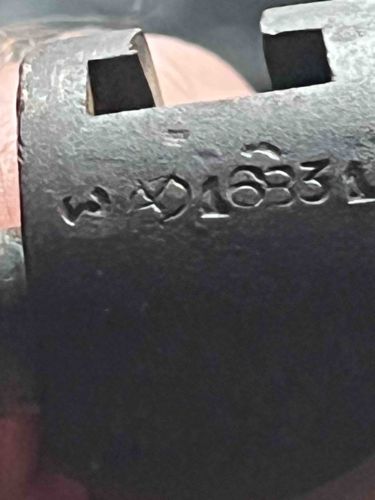
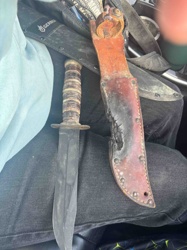
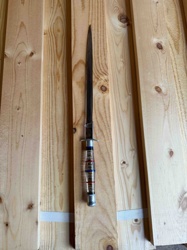
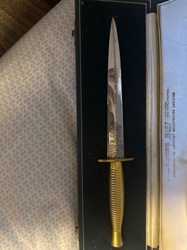
This item is the ricasso and guard area of what appears to be a Japanese Type 30 Arisaka Bayonet, specifically designed for use with the Arisaka rifle series. The material is a dark, presumably blued or patinated steel, exhibiting a matte finish with visible signs of wear and surface oxidation consistent with age and military use. The visible section includes a portion of the crossguard with a prominent muzzle ring, which is a key characteristic of the Type 30 bayonet, allowing it to be affixed over the rifle's barrel. The tang is broad and robust, typical for a combat bayonet. Crucially, stamped into the metal are markings, which include a series of kanji characters followed by numbers. While difficult to decipher fully from the image alone, the characters appear to be the 'stacked cannonballs' logo, which signifies manufacture by the Kokura Arsenal in Japan. Following this mark are the serial numbers, which clearly read '91831'. The stamping shows good depth and clarity, indicating original manufacture rather than a post-production alteration. The edges of the muzzle ring show some slight blunting and minor imperfections, consistent with handling and potential deployment. There is no significant evidence of severe damage like bends or major pitting, suggesting a reasonable state of preservation for a military artifact of this vintage. The overall robust construction and standardized markings are indicative of mass production for military purposes during the mid-20th century, specifically the WWII era.
AI Appraisal Report
I have examined the provided image of what appears to be the ricasso and guard section of a Japanese Type 30 Arisaka Bayonet. Based on this visual examination, the item presents as authentic. The presence of the distinctive 'stacked cannonballs' logo for the Kokura Arsenal, combined with the clearly visible serial number '91831', strongly supports its originality. The wear patterns, blued or patinated finish, and minor imperfections on the muzzle ring are consistent with a military artifact of this age, suggesting genuine use rather than reproduction. The robust construction is typical of mass-produced WWII-era Japanese edged weaponry.
In terms of market conditions, Japanese Type 30 Arisaka bayonets, especially those with clear arsenal markings, generally have consistent demand among military collectors. While not exceptionally rare, complete examples in good condition are sought after. This item, being only a section, diminishes its value significantly compared to a complete bayonet. However, it still holds collector interest due to the identifiable arsenal mark and serial number.
Factors impacting value include its incomplete nature. If this were a complete bayonet in similar condition, its value would be considerably higher. Its excellent provenance (Kokura Arsenal) and discernible serial number are positive attributes.
It is crucial to note the limitations of authenticity verification from images alone. While visual cues are strong, a complete authentication would require an in-person examination to assess the steel's metallurgy, weight, proper dimensions, and tactile feel. Verifying the absence of any subtle repairs or alterations, which are difficult to spot in photographs, would be paramount. Provenance documentation, if available, linking it to a specific unit or soldier, would significantly enhance its historical value and, consequently, its market worth. Without these, my assessment is based solely on the visual information provided.